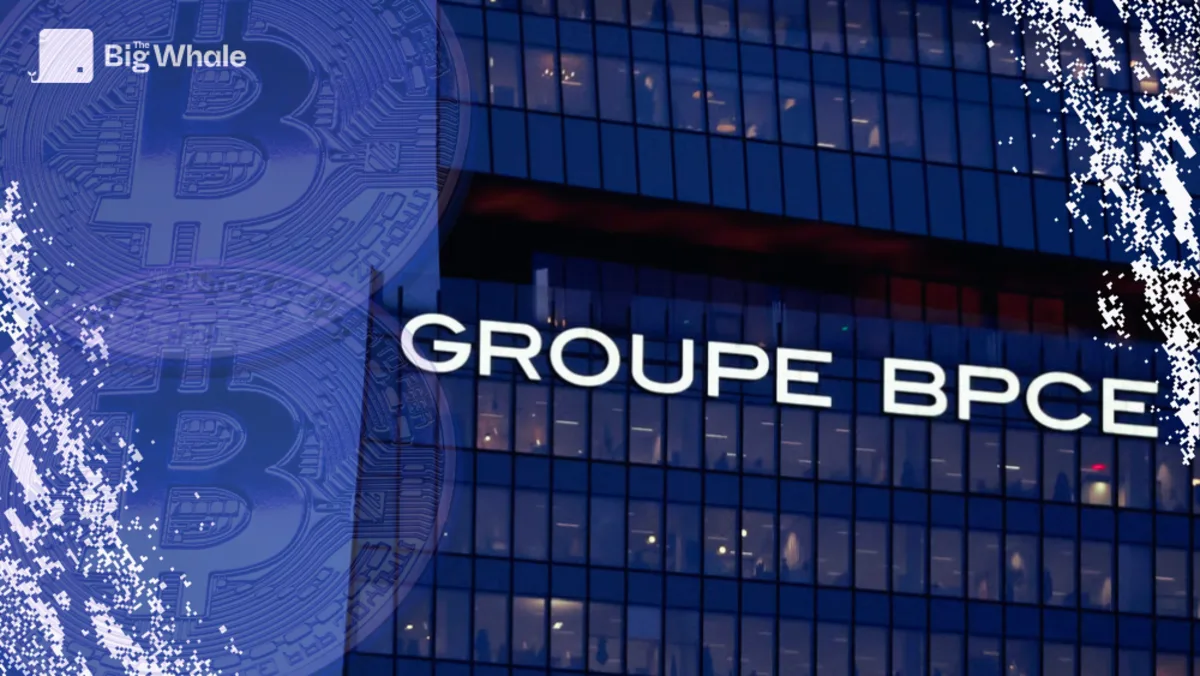
EXCLUSIVE. BPCE now allows its customers to buy and sell cryptos
Ask AI TO SUMMARIZE ThIS ARTICLE

From Monday, customers of the French banking giant will be able to buy bitcoin, ether, sol and USDC directly from their application. The service is available in 4 of the group's 29 entities (Banques Populaires and Caisses d'Epargne) and will gradually be extended to the whole of France.

Your 2 free articles this month are up

The research your peers are already leveraging

The Big Whale gives financial institutions the market intelligence, network, and platform to move with confidence in digital assets. Trusted by 150+ firms.

A small revolution. After more than a year of development, customers of the BPCE banking group will be able to buy and sell cryptocurrencies from Monday - a first in France for a major traditional bank, while BPCE manages more than €900 billion in assets and reaches nearly one in five French people through its networks.

According to our information, this first phase concerns customers of 4 regional entities out of the 29 that the group has, representing around 2 million customers (out of more than 12 million in total): Banque Populaire Île-de-France and Caisse d'Épargne Provence-Alpes-Côte d'Azur are among the 4 entities concerned.

The services will be opened up to the other entities during 2026, gradually. "The aim is to see how the service takes off," explains someone close to the bank.

Buying and selling will take place directly in the Caisse d'Épargne and Banque Populaire applications via an account dedicated to digital assets, charged at €2.99 per month, with a commission of 1.5% on each purchase/sale (minimum charge of €1 per transaction).

The accounts are managed by Hexarq, the crypto subsidiary of the BPCE group, which will also provide custody of the assets.

As we revealed a year ago, Hexarq has obtained enhanced PSAN registration, enabling it to offer custody, the purchase/sale of cryptos against euros and crypto-crypto exchange.

Also according to our information, Hexarq applied a few months ago for MiCA approval, the new European regulation. It is expected to obtain it in the coming weeks, which would allow BPCE to be one of the first major European banking groups to operate under this regime.

Bitcoin, ether, sol and USDC

To begin with, customers can buy four digital assets: bitcoin, ether, sol and USDC (Circle's stablecoin dollar). "These are the most in demand," explains someone close to the bank.

Other cryptocurrencies will be added gradually to reach around 15 assets available.

The point of the USDC is to allow customers to sell their bitcoin or ether and reposition themselves on a stablecoin without triggering a tax event - stablecoins are considered digital assets in the same way as other cryptocurrencies (and not fiat currencies).

The integration of a euro stablecoin is also planned.

This launch comes as banks accelerate on digital assets, amid increased competition from fintechs such as Revolut or Trade Republic, which now have several million crypto users in Europe.

While some institutions have chosen to focus on services for businesses - such as Deutsche Bank - others are now targeting individuals. "There are real challenges in terms of retaining and even winning over new customers", explains one banker.

This is particularly the case with Spanish banks Santander and BBVA, pioneers on the subject in Europe:

- BBVA now allows its Spanish customers to buy, sell and hold Bitcoin and Ether directly via its banking application, with in-house custody and 24-hour trading.

- Santander, via its digital subsidiary Openbank, has launched retail access to Bitcoin, Ether, Litecoin, Polygon and Cardano, with integrated trading and custody, and transparent transaction fees.

Others like Commerzbank have decided to work with crypto-native players such as Deblock. The German bank has just invested in Series A (€30 million) of the Franco-English start-up.

In France, meanwhile, BoursoBank a few months ago opened access to crypto ETPs from its app, testifying to traditional banks' growing interest in the digital asset market.

Format
News
Raphaël Bloch

Raphaël Bloch is CEO and co-founder of The Big Whale, an independent market intelligence platform on digital assets serving financial market participants through editorial coverage, research, a weekly briefing, and in-person events. He co-founded The Big Whale in April 2022. At the platform, he moderates and hosts institutional events bringing together banks, asset managers, custodians, and infrastructure providers on topics including staking, on-chain yield, stablecoins, DeFi lending, and tokenisation. He has moderated panels at events hosted in partnership with Bitwise, Everstake, Gemini, Morpho, Hexarq, Coinhouse, Delubac, Franklin Templeton, and the Ethereum Foundation, held in London and Paris between late 2025 and mid-2026.

Before founding The Big Whale, Bloch worked as a reporter at Les Echos from December 2016 to March 2020, then at L'Express from March 2020 to March 2022. He also previously worked at Reuters. Since September 2022, he has held a concurrent role as Business Analyst at BFM Business. He has been active in crypto journalism since 2016. He holds degrees from emlyon and the CFJ.

See all articles ↗
Grégory Raymond

Grégory Raymond is Head of Research and co-founder of The Big Whale. A specialist at the intersection of traditional finance and digital assets, he has been covering the regulatory, institutional and technological developments of the sector since 2017 for an audience of decision-makers: ,banks, asset managers and fintechs. He is also the author of Bitcoin & Cryptos: L'enjeu du siècle (Talent Éditions, 2025), a book built around interviews with key figures from the ecosystem.
See all articles ↗
Subscribe to The Drop
The leading weekly briefing on digital assets for financial institutions: independent analysis, reports, benchmarks and exclusive events, delivered to your inbox.
Read by 30,000 professionals
November 12–13, 2026

The Geneva Summit

The Corporate Gateway: where the future of onchain finance is decided. 300 handpicked decision-makers. One shared mandate.
300
Decision-makers
2 days
Intensive program