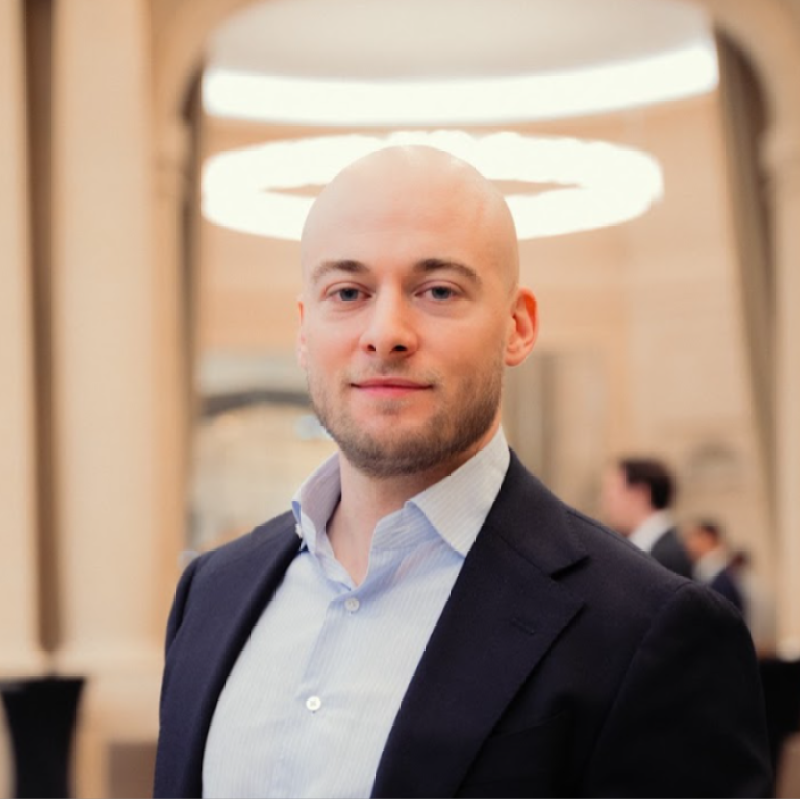
Karl Chappe-Gatien (High Stakes Capital): "DEXs like Hyperliquid will gain in popularity".

Ask AI TO SUMMARIZE ThIS ARTICLE

As part of our 'season' dedicated to derivatives trading platforms, we spoke to Karl Chappe-Gatien, an independent French trader better known by the name 'High Stakes Capital'.

Your 2 free articles this month are up

The research your peers are already leveraging

The Big Whale gives financial institutions the market intelligence, network, and platform to move with confidence in digital assets. Trusted by 150+ firms.

The Big Whale: You are currently a trader at Bybit. What made you choose this particular platform, and what advantages do you find it has over other platforms?

Karl Chappe-Gatien: After the closure of FTX, I had to find a new "home". I first talked with Binance, but they no longer accept French people for derivatives trading. So I turned to Bybit, which was suitable at the time. The user interface is pretty good and the trading volume is satisfactory.

However, Bybit recently banned all French people from accessing it. Today, if you are French, even if you live abroad, you can no longer trade on Bybit (this provision is theoretical as it is not the case, editor's note). The situation is becoming increasingly complicated for French people. That's why I think that decentralised exchange platforms (DEX) will gain in popularity.

As you've already mentioned, you're based in Dubai, where regulation is less strict for platforms, particularly with regard to crypto derivatives trading and in general. What would you recommend to a European user, taking regulatory constraints into account?

It depends on your objectives. For spot trading or simply to buy and hold cryptos, Binance remains the best option. It offers a wide range of cryptocurrencies and probably the best liquidity on the market to date.

On the other hand, for leveraged trading, it's more complex as Binance and Bybit no longer accept French users. There are alternatives such as Bitget (which is not registered as a PSAN in France, editor's note).

You are one of the best independent traders in the world. How does Bybit manage to retain you? Are there any special programmes or an exclusive contract?

Not at all. I chose Bybit simply because I needed a platform that could handle large volumes. There are a lot of preconceived ideas about the relationship between traders and platforms, but in my case I have no particular advantage. As a top-level 'VIP' member, I get a partial refund of trading fees and priority treatment in the event of a specific problem. I could have advertised for them, but that doesn't really interest me.

You suffered the full brunt of FTX's bankruptcy. Do you keep your assets on the platforms?

Actually, I keep a large proportion of my assets on the platforms, as I often take long positions. However, I split my assets between several platforms. When FTX closed, only 35% of my total portfolio was exposed to it.

Currently, I mainly use two platforms: Binance for spot trading on altcoins, and Bybit for leveraged trading, mainly on Bitcoin and Ethereum.

Today, many traditional players are positioning themselves on crypto. We have Revolut in Europe, Robinhoodin the US, and various banks getting involved. What do you think of this trend?

Players like Revolut or Robinhood are positioning themselves on crypto, but they are not designed for sophisticated crypto users. It's good that they offer this service as a complement. Personally, I've discussed it with my bank, and I think that in the future I could trade via my bank if it offered this type of service.

After the FTX collapse, trust in platforms has become a major issue. Even if platforms like Binance publish their reserves transparently, you can never be 100% sure. A reputable Swiss bank can offer guarantees that crypto exchanges simply can't match.

Do you use decentralised platforms, particularly for derivatives?

Actually, no, because the volumes aren't sufficient. I mainly use them to buy memecoins or cryptocurrencies that are not listed on centralised exchange platforms. However, I think that in the future, DEXs like Hyperliquid will gain in popularity.

For now, the regulatory future remains uncertain. Take Uniswap, for example, which is facing significant challenges with the SEC (Securities and Exchange Commission). Personally, I'd like to use DEX more. It's truer to the spirit of crypto than trading with my bank. If a solution emerges that offers sufficient volume, I'd happily adopt it.

Louis Tellier

Louis Tellier is Lead Institutional Research at Blockstories, where he focuses on developing the institutional offering for digital assets. He joined Blockstories in April 2025. Blockstories was founded in 2022 and is headquartered in Berlin, with presence in France and Switzerland.

Prior to joining Blockstories, Tellier worked as a crypto journalist at The Big Whale from August 2023 to January 2025, covering crypto and blockchain topics. Before that, he was a journalist at L'AGEFI from May 2022 to July 2023, specialising in cryptocurrencies. Earlier in his career, he worked as a web and video journalist at BFM Business and as a video journalist at Le Figaro. He also taught journalism at IICP in Paris for three and a half years, with a focus on web video journalism. Tellier is a graduate of Sciences Po Grenoble and the University of Lille.

See all articles ↗
Raphaël Bloch

Raphaël Bloch is CEO and co-founder of The Big Whale, an independent market intelligence platform on digital assets serving financial market participants through editorial coverage, research, a weekly briefing, and in-person events. He co-founded The Big Whale in April 2022. At the platform, he moderates and hosts institutional events bringing together banks, asset managers, custodians, and infrastructure providers on topics including staking, on-chain yield, stablecoins, DeFi lending, and tokenisation. He has moderated panels at events hosted in partnership with Bitwise, Everstake, Gemini, Morpho, Hexarq, Coinhouse, Delubac, Franklin Templeton, and the Ethereum Foundation, held in London and Paris between late 2025 and mid-2026.

Before founding The Big Whale, Bloch worked as a reporter at Les Echos from December 2016 to March 2020, then at L'Express from March 2020 to March 2022. He also previously worked at Reuters. Since September 2022, he has held a concurrent role as Business Analyst at BFM Business. He has been active in crypto journalism since 2016. He holds degrees from emlyon and the CFJ.
See all articles ↗
Subscribe to The Drop
The leading weekly briefing on digital assets for financial institutions: independent analysis, reports, benchmarks and exclusive events, delivered to your inbox.
Read by 30,000 professionals
November 12–13, 2026

The Geneva Summit

The Corporate Gateway: where the future of onchain finance is decided. 300 handpicked decision-makers. One shared mandate.
300
Decision-makers
2 days
Intensive program