


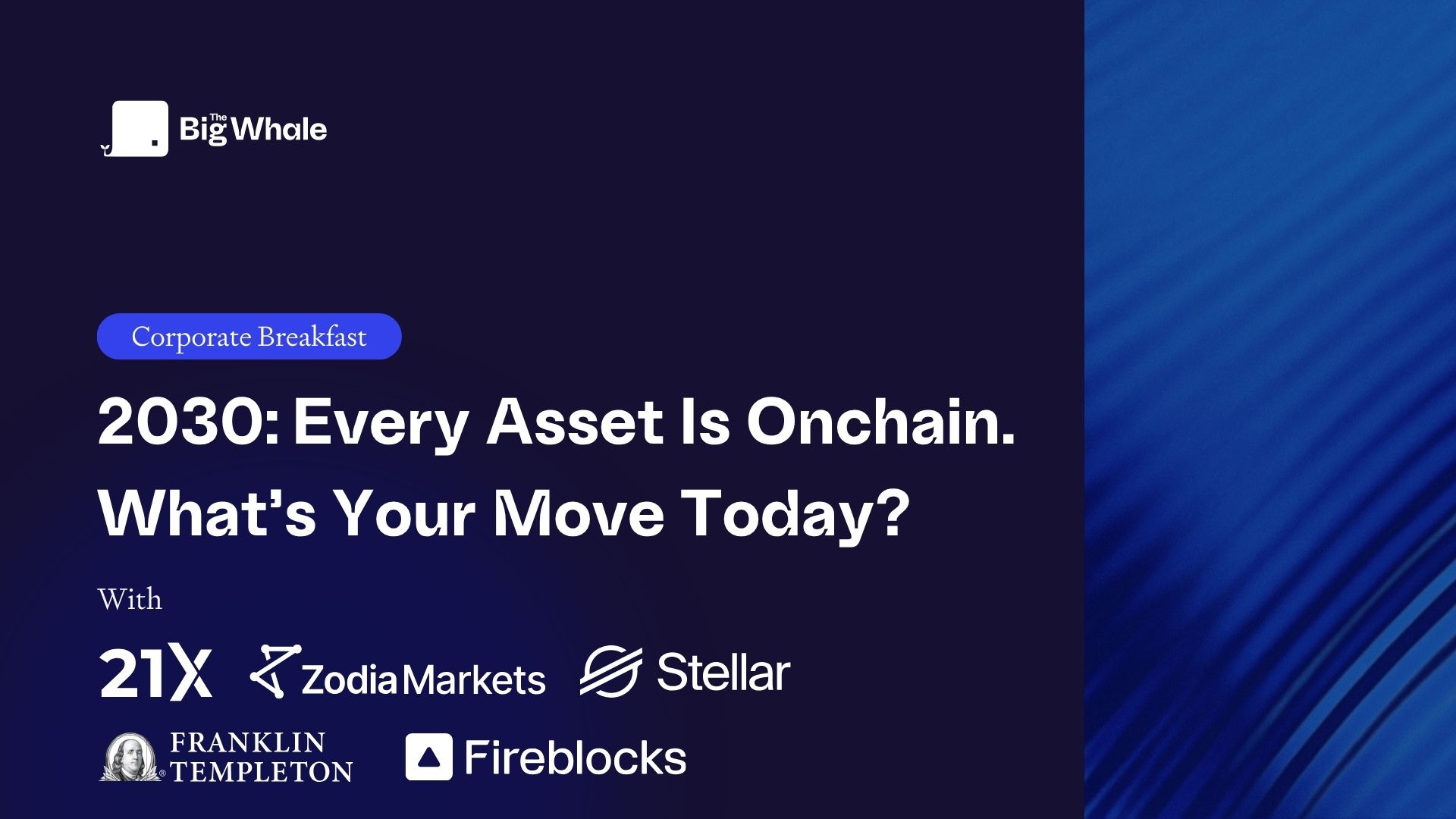
Speakers
Why Tokenized Assets Need New Rails to Actually Work
- Paulina Tylus, Global Partnerships & Client Relations Director at Zodia Markets
- Lauren Strasburg, Director RWA Partnerships at Stellar Development Foundation
- Marek Socha, MD Global Markets at 21X
How Treasury Management Becomes the On-Ramp to the Onchain Era
- Rafael Mastroberardino, Digital Assets at Franklin Templeton
- Marek Socha, MD Global Markets at 21x
- Alexandre Chessé, Head of Sales EMEA Banking & TradFi at Fireblocks
Traditional rails are expensive, not broken
The problem is not reliability. It is cost, speed and friction built into every layer of the stack. Two concrete benchmarks from the room:
- A $2M transfer from Paris to Singapore: multiple correspondent banks, several days, ~3% cost, no weekend availability
- 50,000 transactions on Franklin Templeton's legacy rails: $50,000 total (~$1 each). Same 50,000 on Stellar: $120. More than 99% cost reduction.
At 21X, trading, clearing and settlement — three distinct legal entities, three systems — collapse into one atomic on-chain transaction, with no settlement failure and no capital buffer tied up between steps.
Native tokenization and digital twins will coexist, then converge
Two models are running in parallel today:
- Digital twins: token moves, legal ownership stays off-chain. WisdomTree has 15 products on Stellar (international equity, US equity, private credit, gold) using this approach
- Native issuance: transfer agent and share registry run on-chain, ownership moves with the token. That is what Benji does.
The direction of travel is clear. The DTCC's decision to bring its tokenization project to Stellar — 2027 launch target — will shift the market toward native issuance at scale. Once the world's largest securities settlement institution goes native, the infrastructure debate is over.
Benji's three waves show how institutional adoption actually unfolds
Franklin Templeton's Benji is now at $2.6 billion on Stellar and Ethereum, five years after launch. The adoption curve ran in three distinct waves:
- Wave 1: Fintechs and VCs post-2023 banking stress — treasury security, escaping bank credit risk
- Wave 2: Hedge funds and market makers — collateral efficiency, yield accrual while trading, smaller capital buffers
- Wave 3: Traditional Franklin Templeton clients, including a state-owned institution that invested in Benji on Stellar last week
Each wave unlocked the next. Features built for wave-one customers — intraday yield, peer-to-peer transfer — became the primary selling points for wave two.
Collateral mobility is the most underrated use case
Today's collateral stack: slow, static, requires 10-20% buffers. Examples of what 24/7 atomic settlement changes:
- A margin call on a Sunday can be met by moving tokenized treasuries instantly
- Intercompany transfers between branches no longer require selling a money market fund, waiting days to clear, transferring and buying back — losing up to a week of yield in the process
- Capital buffers built to absorb settlement lag shrink significantly as that lag disappears
This is a structural efficiency gain across the institutional system, not a marginal one.
The human factor is the last bottleneck
Fireblocks surveyed 640+ C-level leaders from financial institutions and corporates. 88% confirmed budget and resources allocated to blockchain infrastructure for 2026. The technical case is made. What is lagging:
- Institutional treasury teams with decades of TradFi experience who cannot openly admit they do not understand digital custody
- Uncertainty around compliance, auditability and true ownership of on-chain assets
- Education cycles that run months before a first trade happens
The gap is not conviction at the top. It is operational readiness in the middle.
Conclusion
By 2030, on-chain treasury infrastructure will be standard equipment for institutional finance. Cost savings are documented, products are live and the adoption curve has reached state-owned institutions. What the Paris conversation confirmed is that the path runs through specifics: which asset class, which jurisdiction, which problem is actually being solved. The institutions best positioned are not those that move first in a generic sense — they are those that pick the right use case and execute it completely.
.png)













%201.png)
%201.png)














%201.png)