

TL;DR
- Asked what best describes vaults, about 40% of the room saw them as the next default for asset management, 40% as a new legal and technical shell for the same players, and the rest found the picture unclear. Stéphane Heip sided with the second view, and the final vote moved slightly in that direction.
- Stéphane Heip separates DeFi vaults, which trade directly on protocols such as Aave or Morpho, from RWA vaults, which run regulated strategies such as tokenized money market, private credit or real estate funds.
- RWA vaults follow existing fund rules. DeFi vaults remain a grey zone: nobody has said when a vault becomes a fund, or who carries fiduciary duty when something goes wrong.
- A French asset manager said its regulator allowed it to curate vaults on the condition of following the rules for alternative investment funds, a first sign of how supervisors may approach the question.
- Most tokenized funds today are digital twins of existing funds, with few investors and little composability. For Stéphane Heip, the key to scale is letting investors in without crypto or a wallet.
- Stéphane Heip sees the most growth in RWA vaults for now, and expects DeFi vaults to become the reference only if most assets end up natively onchain.
Speakers
Are Vaults the Future Default for Asset Management, or Just DeFi's Version of a Hedge Fund Wrapper?
- Stéphane Heip, CEO at Enzyme
The workshop was held under the Chatham House Rule: statements by participants are reported without names or affiliations.
Two kinds of vaults
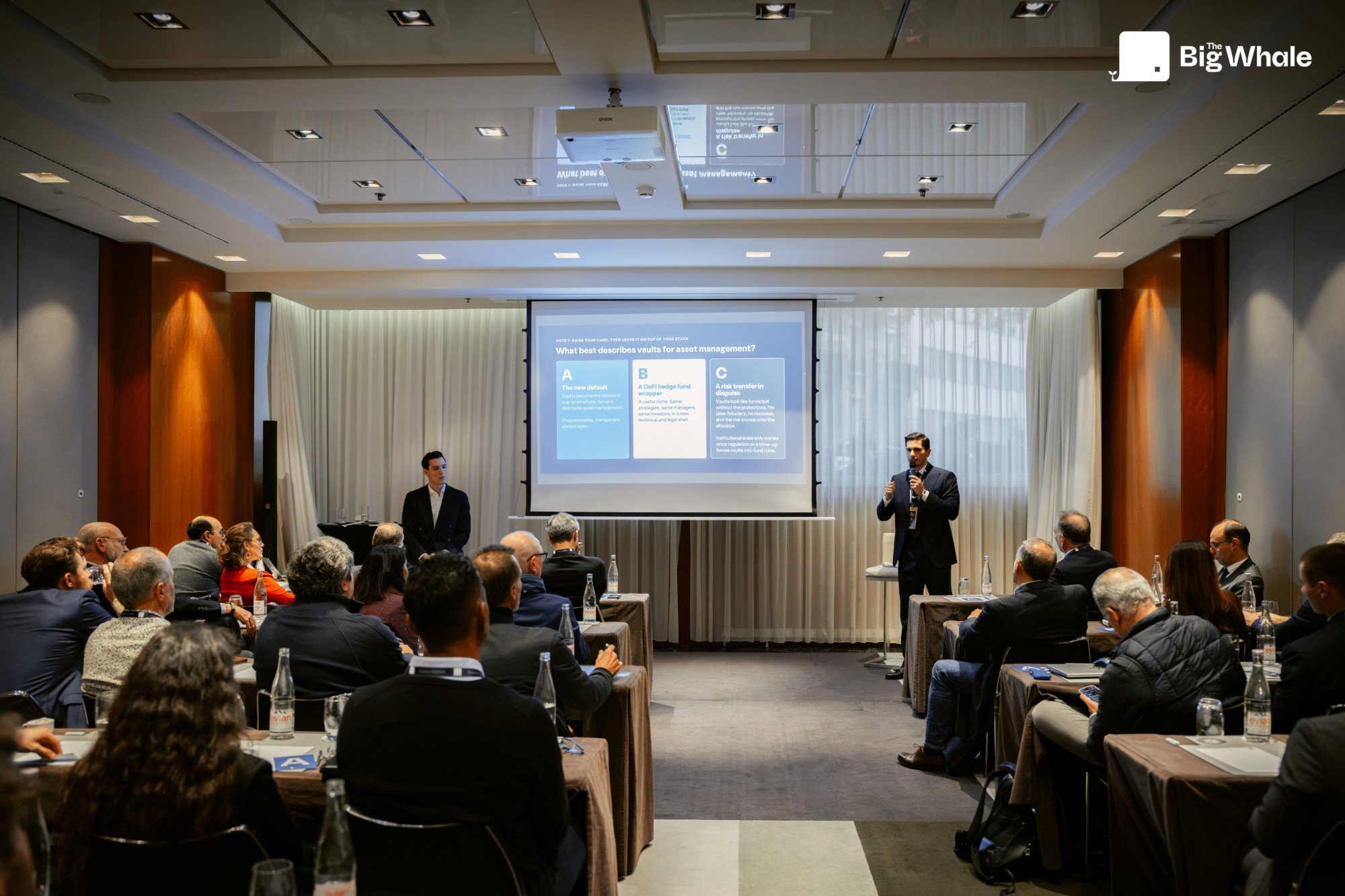
The room voted on what best describes vaults: the next default for asset management, a new legal and technical shell for the same players and distribution channels, or something still unclear, with no answer on who holds the risk, who is the fiduciary and how vaults can be audited. About 40% chose the first answer, 40% the second and the rest the third.
Stéphane Heip, a former lawyer, started with a definition: a vault is a smart contract that collects deposits from several investors, mints a token representing each investment and burns it on redemption. Stéphane Heip separates two families:
- DeFi vaults, where the smart contract trades directly on decentralized protocols such as Aave or Morpho, the purest form of a decentralized pooled vehicle and the most programmable
- RWA vaults, the segment where Enzyme works, which power tokenized real estate, private credit and money market funds as well as tokenized hedge funds
Both share four features: instant delivery versus payment, the blockchain as the register of who owns what, a pooled investment vehicle, and tokens that can be used elsewhere, for example as collateral.
Stéphane Heip leaned towards the second answer, with one correction: a vault is a fund wrapper, which can hold real estate, private credit or money market strategies as well as hedge fund strategies. The first answer overstates the case, since a large share of European assets under management sits in separately managed accounts. For Stéphane Heip, vaults are an evolution in how funds are run, replacing legacy technology with smart contracts and adding programmability and composability.
When does a vault become a fund?
For Stéphane Heip, the third answer applies to DeFi vaults only. A tokenized money market fund issued in the EU through a vault falls under the same rules as any money market fund, with a transfer agent, an authorised manager and distributors licensed under MiFID. DeFi vaults are a grey zone: their builders count on code replacing human intervention to stay outside regulation, while no regulator has said what the legal status of a vault deployed on a lending protocol is, or who carries fiduciary duty.
Stéphane Heip gave the example of a DeFi vault behind a yield product offered on a large exchange: if it counts as a fund, the exchange would need a distribution licence and the manager would need authorisation as a fund manager. Participants added their own readings:
- A participant warned that tokens representing claims on shares and circulating freely recall the bearer instruments regulators spent twenty years eliminating
- Another participant said existing criteria for alternative investment funds could lead supervisors to treat vault providers as fund managers, and that a lack of KYC does not stop a vehicle from being a fund
- A participant running a regulated asset management company in France said its supervisor allowed it in July to curate vaults on the condition of following the rules for alternative investment funds, including a minimum investment of €100,000 and permissioned access
Stéphane Heip expects a clash between regulators and market participants over legacy roles. In the US, tokenized money market funds still need a transfer agent, even though the blockchain does the record-keeping, and a new status for digital asset transfer agents has started to adapt the rules. For Stéphane Heip, the question is less the work itself than who is accountable for it.
Wrappers today, native funds later
For now, most vaults repackage existing strategies. Stéphane Heip described BlackRock's tokenized money market fund as one of the most successful, yet limited to around twenty qualified investors, with whitelisted transfers and little secondary trading. Composability is also behind schedule: holders cannot yet use these fund shares on lending protocols. Vaults can also create natively tokenized funds, which Stéphane Heip expects once firms accept more risk.
On economics, Stéphane Heip does not think tokenized funds save money yet. The main gain is simpler management, and fees may fall only if transfer agents and other providers end up doing less. Infrastructure pricing varies widely between providers, from free to one-off fees of up to 150,000, combined with variable fees on assets under management.
For Stéphane Heip, 90% of a vault's success comes from its strategy. The next factor is distribution: managers often ask for help finding investors, and requiring investors to hold crypto and a wallet cuts out 95% or more of the market. Enzyme is building onboarding paths that let anyone invest without either. Asset managers choosing a provider should look at what the smart contracts can do, such as daily dividends or multiple share classes, at the tools to operate them, and at speed, since many firms run early projects to build processes with their custodians and transfer agents.
Who do you call when something goes wrong?
The moderator relayed a concern from a large bank at a recent event: with blockchain speed, institutions cannot intervene when something goes wrong, which raises the question of whether some latency should be reintroduced. For DeFi vaults, Stéphane Heip said responsibility depends on the problem:
- A smart contract flaw falls on the technology provider
- A risk management failure, such as vaults that closed after exposure to fragile stablecoin loops, falls on the curator, who designs and runs the strategy
- Regulators would likely call the curators first, then the issuer or distributor, and probably everyone involved
Protocols audit their own smart contracts through specialist firms before any large-scale distribution. According to Stéphane Heip, the main risks now lie around the protocol, in private key compromise and social engineering. Enzyme does not provide custody and leaves the choice of custodian to clients. A participant cited a recent oracle manipulation affecting a curated vault, where the infrastructure team recovered most of the funds, as an example of responsibility that nobody formally holds.
Where vaults are used today
Stéphane Heip listed the use cases with traction: curated lending and stablecoin yield, often embedded in fintech apps, then tokenized funds, led by money market funds and now spreading to private credit and real estate. For Stéphane Heip, the wider tokenization of funds will take years. The landscape includes DeFi protocols such as Aave and Morpho, whose vaults serve their own lending markets, DeFi vault providers, RWA infrastructure providers such as Enzyme or Centrifuge, financial service providers such as transfer agents and custodians, and curators.
In an RWA vault, the usual roles remain: manager, custodian, transfer agent and fund administrator. A DeFi vault usually involves only the infrastructure provider and a curator, with the NAV calculated automatically from onchain data and the blockchain acting as the register.
Conclusion
In the final vote, the second answer gained a few votes and some participants still chose unclear, citing the lack of a clear fiduciary. Stéphane Heip sees the most growth in RWA vaults for now, since most liquidity sits in traditional markets. If most assets end up natively onchain, DeFi vaults could become the reference model in the long run, a scenario Stéphane Heip places years away. Stéphane Heip's advice to managers is to put the product in front of investors who are not crypto-native and to work on onboarding and composability beyond primary issuance.