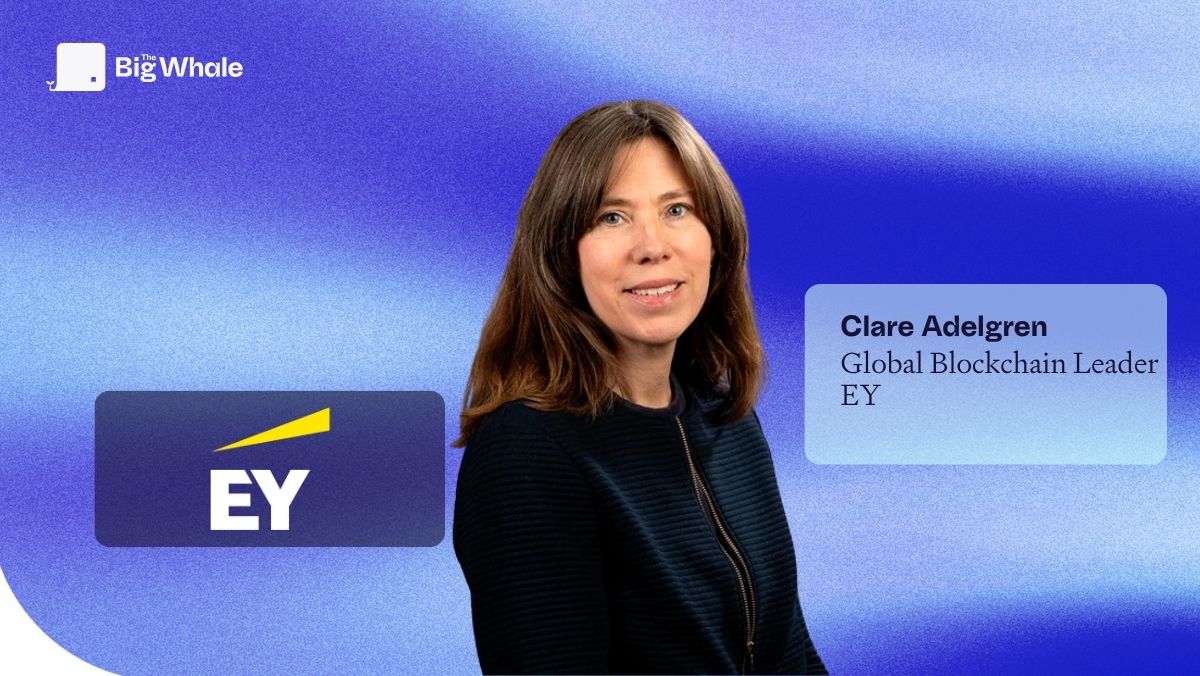
Is DeFi a mature market today, and what is the one factor that convinces you?
In the aspects that matter, yes, I see it as a mature market. And I'm not referring to token prices. I think sometimes we wrap two things together. The stronger test of a mature market is whether durable infrastructure is in place. Crypto is 17 years in now, and we have regulated custodians, institutional trading venues, stablecoin networks and tokenization. You have all of these components, and that is why I would say it is a mature market. It is an asset class that has attracted significant investor interest. It is volatile, and it is one that many, many people want in their portfolios. I believe it is there to stay.
"It is a misnomer to think it is an either/or. This is very much an and."
Many people we speak to expect DeFi to stay marginal, because of the hacks and because trust can't be expressed the way it is in TradFi. Do you agree, or do you have a counter-thesis?
I can understand why people read it that way, but I see it a little differently. Crypto is almost the first use case. It is an asset, and that is the way we see it. What we are seeing in the marketplace today is institutions taking those same crypto rails, that same infrastructure and technology, and starting to implement it for their own needs. Their needs mean doing it in a more regulated, compliant way, and that is the build-out. It is almost a next phase.
What we are working toward is a technology being adopted by different ecosystem constituents for their needs, and I think that is incredibly healthy. At some point these worlds will cohabitate, each with its own function, need and purpose. It is a misnomer to think it is an either/or. This is very much an and. And the speed it is moving at right now is incredibly indicative of why this matters to institutions.
What separates the crypto businesses and projects coming to market today from those of the last cycle?
I don't know that different things are coming. I think we are in a different phase. The market is evolving really quickly, and I am focused on the new activity that institutions are driving. What is clear is that institutions are no longer asking whether the technology works. They are building, and they are increasingly building to scale. Until now you have seen the component parts come together: custody, tokenized assets, digital money, the settlement infrastructure. But those parts don't yet create a cohesive market.
I was in London recently, at an event with a tremendous number of institutions, and the focus in the room was on this next phase being about bringing the constituents together: issuers, investors, banks, infrastructure providers, regulators. Everybody has to come together to create real use cases and, importantly, the end-to-end flow. You need both ends of the flow to have that market and to start to see the scale people are looking for. So I see the next phase as being about coordination, not so much about proving the technology.
How serious were the institutions in that room about deploying capital to make these flows happen?
I walked away feeling energized. The focus was all about utility, and about the things that need to get done. I don't think there is hesitation, but there is a really big understanding in the room that you need to do it and do it right. That means everybody is building out risk frameworks and governance, and thinking hard about what it takes to operationalize and move forward. The seriousness was very compelling, and there was a definite call to action.
So the appetite is there. But institutions will do it at their own pace.
What were the top use cases discussed?
Stablecoins are still very top of mind. But because of the discussion we were having, we were focused on wholesale markets and how they should move, which I think is very indicative of where we are. If you take a step back, I think we can see maturity in stablecoins. People understand the utility. A lot of the early business cases are about treasury, liquidity and settlement, and about the efficiencies within the institution. You are seeing pockets where tokenization is coming, but at the moment that is also about efficiencies within the institution, and they are building the rails for it. The conversation is very utility-focused: what is the use case, what do we need for it, and thinking holistically about that.
If a corporate treasurer or CFO looks at stablecoins, tokenized deposits and wholesale CBDC, what should they focus on? Is there a use case for all three?
You have to put yourself in the seat of a CFO. You can't jump to the asset. You have to sit back and ask what the use case is and what you are trying to achieve. CFOs, for a start, don't really care about blockchain for blockchain's sake. None of them will be there just because it looks and sounds good. What they care about is cash flow, control and return on liquidity. You can break it down: stablecoins and tokenized money can compress settlement cycles, improve visibility over cash positions and potentially enable new financing models.
But I think the more interesting question isn't whether the money can move faster. It is who benefits when it does. Is it the buyer or the supplier? Remember, a CFO can represent either one. Is it the bank, the platform? That redistribution of liquidity economics is where CFOs will start to focus and think about value creation. In my view it will also become a really important aspect of competitive edge. It will back into the choices on tokenized deposits and stablecoins, and shape some of those offerings. There is always a purpose. And there is a really interesting opportunity if you think of it as programmable: what does programmable money movement create?
"The real breakthrough comes from giving firms the ability to choose when to settle, when to extend credit, when to automate the conditions between those two things."
For readers who run non-financial businesses, such as supply chains with many vendors, what would instant settlement change for working capital and treasury?
Historically, we have built business processes around the assumption that money takes time to move. That is why we have reconciliation teams and liquidity buffers, and why there is often a complex network of intermediaries involved in running a supply chain or the operations of a large organization. When you think about settlement approaching real time, many of those operating assumptions can be re-engineered. That is quite a profound shift for finance.
Instant settlement is not always going to be the end objective. Credit terms, netting and liquidity management are all still very valuable levers. I think the real breakthrough comes from giving firms the ability to choose when to settle, when to extend credit, when to automate the conditions between those two things. That lets you redesign some of those processes quite fundamentally.
Take 90-day payment terms, 120 for some. They exist because we assume it takes time to move money. If you can redesign that, what would it do? Who does it benefit? What might it change in our ability to run a more efficient, more profitable business, and in how I interact with my vendors and my customers? It can be very profound.
"This is about building, and people have got their sleeves rolled up."
You advise institutions on digital assets every day. What are the biggest blockers your clients face?
First, what we do. EY has been in this space for a very long time. We have been investing in it for ten years, both building our own product and running our own core R&D, which focuses on privacy. We also have tremendous capabilities across a broad range of services for our clients, and that gives us depth. Our work comes in two parts. One is that clients are building, and building at scale, so many of the questions are about the detail. What does governance look like? How do I bridge the management frameworks for this back to the ones I have for my institution as a whole?
As for blockers, I don't know that I see them as blockers. The market is moving very quickly. What is harder for institutions is the coordination piece I mentioned: the pieces are all there, but they have to work in harmony, end to end. What happens before and what happens afterward? Do you have both halves of the market available? Do you have secondary liquidity, and how do you access it? It is about putting those end-to-end pieces together so that you have a functioning flow. Everything is a little scattered today, which may be good, because everyone has been busy working on their own piece. Now it is about bringing it all together, and that always takes a little time. It is a natural part of the growth phase of the market.
What is really interesting is what I don't hear now. I don't hear people saying they need to wait for more regulation first. That is not what we hear right now. This is about building instead. Many are moving forward while continuing to strengthen governance, risk management and compliance frameworks, and people have got their sleeves rolled up. It is a different phase.
"There are no shortcuts when you are productizing and building new financial rails."
Over the next 12 months, will institutions get better at putting this puzzle together, or will the scattering persist?
I think we are going to continue to see the same momentum, and I don't see it slowing down in the short term. There are very clear roadmaps. That was one of the discussions in London: people now have a clear plan for how they are going to get there. So I think we will see continued momentum toward building the pieces that are needed. And there aren't any shortcuts. Maturity and product offerings come with the governance and operations I mentioned, not to mention security and cybersecurity. There are no shortcuts when you are productizing and building new financial rails.
But make no mistake, there will also be a rush to get the payback for building that infrastructure. They are building infrastructure right now, and at the end of the day they want the payback. So I don't think it slows down. I think there will be a real acceleration toward growing revenues and scaling around that investment. That is how I rationalize the next two to three years: a continued build.
Are digital asset businesses getting more profitable, or are they still financing themselves through fundraising?
Digital asset businesses can be profitable today. The ones that are tend to be where there is scale and recurring flows, or where the balance sheet economics have been thought through. That is particularly true in stablecoins. Look at the latest earnings from Circle and you can see profitability. There are also examples like Coinbase, where you can see increasing revenue from the subscription services that sit around the infrastructure. So it is definitely possible today.
What we have to understand is that, for institutions, tokenization is at a stage where the market is still paying to build the rails. And it is not as much about the cost of the blockchain itself. Getting to scale is really going to be the unlock for profitability. You can already see that profitability is there, but it goes together with scale, and with sustained volume, liquidity and distribution. Those are the three things you have to have. That is the market that creates it.
"Some fall by the wayside because they don't have a differentiated utility, or haven't thought through the economics of who pays for what."
Do you expect a wave of consolidation among custodians, liquidity providers, market makers and exchanges?
I see this as an evolving market. It is a nascent new market, and what you are describing is a classic phase you go through in building one. You have a lot of players, and then there is consolidation. Some fall by the wayside because they don't have a differentiated utility, or haven't thought through the economics of who pays for what. Some of those basics aren't there, and some will fall away because of that. Then there is consolidation to support scale, which usually comes a little later in the formation of a market. It happens in almost every forming market.
You will also see some of the larger players evolve, as they learn what role they want to play. There will be greater maturity in the offerings and in how firms see themselves and anchor themselves in the market. And like in any supply chain, end to end, different players will try to capture where the value sits. I think we can expect a dynamic, changing picture, and it will be really exciting to watch. Consolidation is another sign of maturity.
Which costs weigh most on these businesses today, and which fall as they scale?
You can generalize a lot in this market, but where the costs sit looks different depending on which piece we are looking at. For institutions right now, you have to think of it as an institutional-grade business: regulatory compliance, risk and governance, custody, security, liquidity, integration with existing legacy systems, distribution. All of those are costs. The bigger chunk of what they are building today is the operational requirements and components that sit around the blockchain. That is where the investment is going.
Looking forward, those are table stakes for a regulated institution. You can't go to market, launch a product and serve your customers without cybersecurity and a clear view of how it works with your broader requirements as an institution. So when I say building the infrastructure, I don't mean just the technical. I mean everything needed to enter this space at all.
Then comes scale. The early use cases already show very big headline volumes in interbank settlement and cross-border payments, and they are great for efficiency. But that is even before the CFO's position and enterprise payments come into the picture. So you can get to scale on these rails and still have an untapped opportunity: serving a much bigger portion of the global payments infrastructure. I do think there is a path. It is a little apples and pears to compare this with crypto, which is its own thing. Crypto is an asset with its own requirements, built in its own way. What we are seeing now is that same infrastructure being built to be institutional-grade, a regulated, compliant version. And the profitability is going to come through scaling that.
"Within a public blockchain you are going to have to solve for privacy, as well as scalability and price point."
Privacy is one of the things institutions now demand. What is Nightfall, and who is it built for?
We are incredibly lucky, if you like, that EY has its own core R&D in this space, and a big focus of that team has always been privacy on a public blockchain. That goes back to the very beginning. From a technology perspective, the core value proposition is decentralization, and that really only exists on a public blockchain. I realize that can be a controversial point of view, especially for some of your members. Think of it as the end game. If you believe that, then you also have to believe that within a public blockchain you are going to have to solve for privacy, as well as scalability and price point. Those are essential if you want to use it at scale in B2B.
It became clear to us that not everybody understood what we mean by privacy. For us it is the ability to retain B2B confidentiality, to transfer privately between parties on a public blockchain, using zero knowledge. And it mattered to us that it wasn't just confidentiality. It had to allow for compliance, and not at the cost of compliance. So it is incredibly important that the technology we built allows for selective disclosure. That is a key ingredient.
Nightfall is in the public domain, and we are incredibly proud of it. The first version went out in 2019, and it has been deployed on several networks, like COTI and PLUME. We have another version coming soon, because we are continuously updating it: there are new proving standards, and we want to make it more efficient and quicker, and to think about the building blocks to scale zero-knowledge privacy. We believe we have a strong approach. Why do we throw it into the mix? Because there are a lot of choices in the marketplace, and we think it is an important element to include as you build out these infrastructure rails. And even when we think about supply chain and some of the opportunities around it, this idea of confidentiality is integral.
Many of us only started thinking about privacy recently. Why has it taken so long to come into focus?
When we first started working on it, the narrative was that anonymity was privacy. That doesn't make sense if you have worked as long and as deeply with enterprises and institutions as we have. The world doesn't operate that way. Nobody does business anonymously. You do business with your customers and your vendors, and it is done in a certain way. Understanding what that looks like was really the core of the question. I have to give a lot of credit to my predecessor, Paul Brody, for much of that vision.
But it is a hard problem to solve, and I think that is one of the reasons it is only coming into focus now, when a lot of the other aspects of the technology are more mature. You are going to see a lot of energy put into it, because it is so critical. It is a more complex part of how this whole technology stack works, but we are getting there. It has become understood, and compliance is becoming much better understood as well. You would never have heard that talked about in 2019. People would have asked why you were thinking that way, because that was not the purpose of crypto. You have to think in terms of the utility of the use cases you are designing for.
"Don't get so caught up in the asset."
What is the one thing CFOs will underestimate over the next 12 to 18 months?
One thing we underestimate in general is that we are constantly talking about the digital asset, and we don't talk enough about the fact that what we are doing is digitizing the infrastructure, with the programmability and function that unlocks. We spend an awful lot of our time debating the value of the digitized asset itself. For me, the value lies in the utility that this programmable infrastructure will provide and that existing infrastructure can't. For a CFO, and in fact for the whole C-suite, understanding that is going to be a big unlock. It prompts the questions: what is my liquidity opportunity, what is my capital management opportunity, what is the opportunity for me in choosing when to settle? That is about the digitization of the infrastructure.
So don't get so caught up in the asset. What is going to differentiate people isn't necessarily who owns it. There will be asset owners, of course, but there are going to be an awful lot of other winners, who take real advantage of the infrastructure for their own commercial purposes, to run more efficient and more effective businesses. I think the winners are going to be the ones actively designing and redesigning their processes and their businesses around it. And I think we are going to see great growth.