

TL;DR
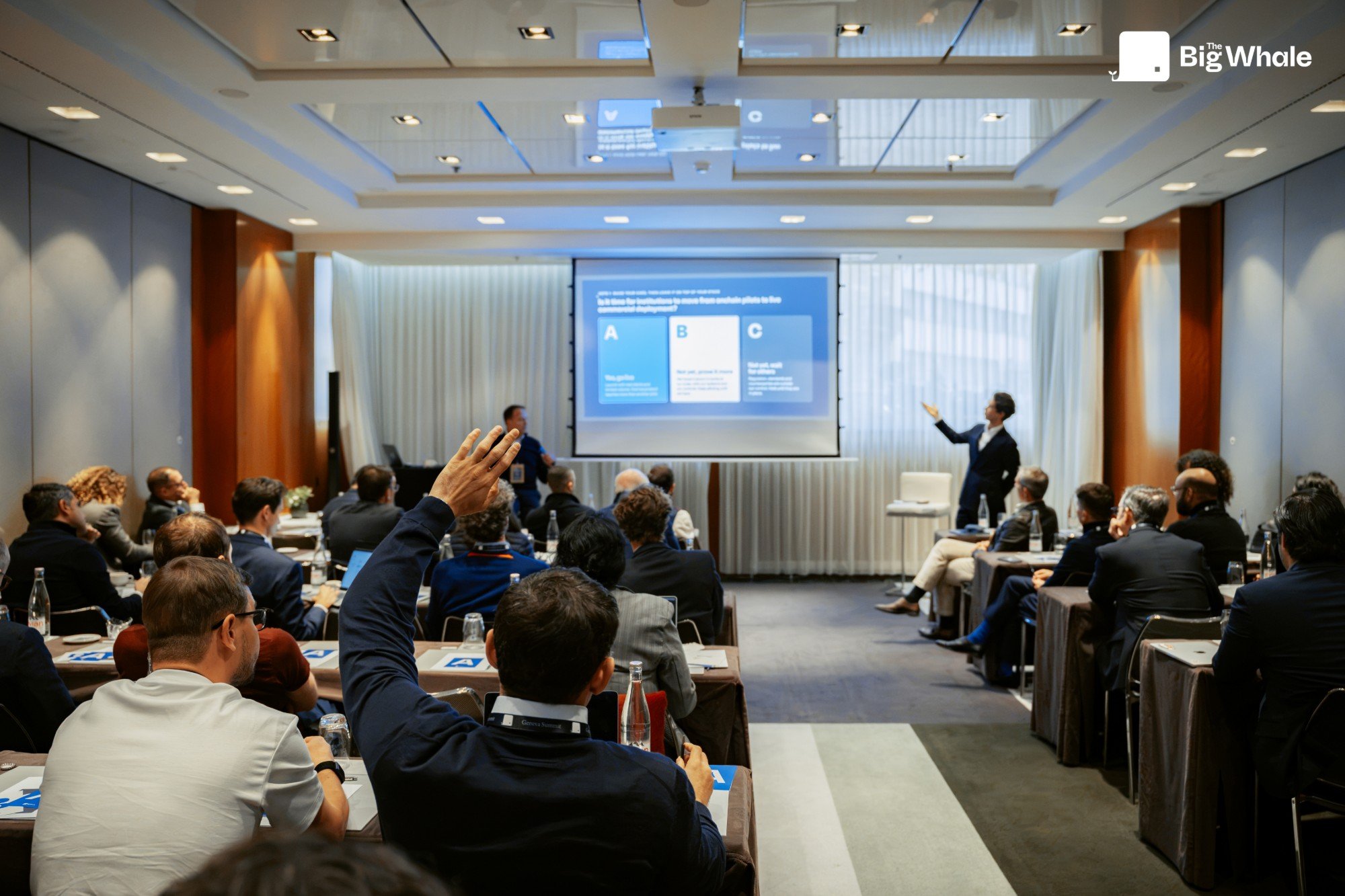
- In the opening vote, a large majority of the room answered A, which participants took to mean going live now. A few answered B, and one participant, speaking from a Swiss perspective, answered C.
- Brian Oliver said the answer depends on the use case: tokenized money market funds have clear distribution and utility, while tokenized private credit and alternative assets still need the rails to be built.
- A participant who delivers software to European banks named accounting departments and legacy technology as the hardest obstacles, ahead of compliance.
- On return on investment, Brian Oliver said firms need to articulate benefits, such as stickier AUM when a tokenized fund share can be used as repo collateral, and pointed to Bullish's $4.2 billion bet on Equiniti.
- Pilots fail when they belong to no strategy with a clear production end state, Brian Oliver said, and serious projects now involve P&L owners, distribution, legal and compliance teams.
- Brian Oliver expects development in custody, tokenized funds, trade finance, US tokenized equities and stablecoin payments, and sees tokenized alternative assets as years away from having an impact.
Speakers
Is It Time for Institutions to Move from Onchain Pilots to Live Commercial Deployment?
- Brian Oliver, VP, RippleX Partnerships at Ripple
The workshop was held under the Chatham House Rule: statements by participants are reported without names or affiliations.
Ripple wants to bring 16 trillion in traditional payments onto digital rails
The recording starts partway through Brian Oliver's presentation of Ripple. In 2025 Ripple made two large acquisitions: GTreasury, a treasury management system used by about 1,200 corporate treasurers globally, and Hidden Road, a non-bank prime broker now called Ripple Prime. Brian Oliver described Ripple's five businesses together as a blockchain infrastructure company. Asked the night before what would transform Ripple in 2027, Brian Oliver gave the answer Ripple's CEO would give: Ripple Treasury and Ripple Prime together see 16 trillion in payments globally, nearly all on traditional rails, and Ripple sees an opportunity to move that to digital. The second opportunity is to combine the five products and services into joint solutions. The moderator then cited a poll The Big Whale ran among corporates and financial institutions: almost 90% said they were committed to building products or investing in the space, and fewer than 20% were already building.
- Participants voted with A, B and C cards. A large majority raised A. A few raised B, and a single participant raised C.
- One participant later summed up the A answer as "it's indeed the time to go live".
Does the answer depend on what you are building?
- Brian Oliver called tokenized funds on the XRPL a clear A, because Ripple has captive distribution through its Ripple Treasury clients and captive utility through Ripple Prime. Tokenization is the means to distribution and utility, which Brian Oliver sees as the key to production scale.
- Ripple focuses on money market funds because they are simpler and well understood, and because tokenized money market funds can already be held as stablecoin reserves. Brian Oliver said the promises made 18 months to two years ago for tokenized private credit and alternative assets have not been met, and placed them under C: the rails have to come first.
- The participant who voted C described a Swiss, distributor-side view: "we're not ready yet", and the firm will wait until networks are built and regulatory questions are resolved.
- A participant launching a stablecoin in Swiss francs voted B, saying the market is only at the beginning and some actors are waiting for new instruments that a younger generation will want. Brian Oliver agreed that the coming wealth transfer to digital natives, who want 24/7 access through an app and no human contact, will be a large catalyst over the medium to long term. In the meantime, institutional use cases can start the flywheel.
Accounting and legacy systems slow banks down
A participant whose firm delivers software to European banks said compliance is a headache when banks decide to go for MiCA and choose a provider, and that the biggest problem then comes from the accounting department. Accountants are responsible for paying taxes, and in most European countries mistakes there can bring criminal charges, so they want clear instructions on debit, credit, VAT and corporate tax. For a Swiss franc stablecoin, they still need to decide whether it sits in cash and cash equivalents or in another asset class on the balance sheet. The second problem is technical legacy: a financial institution needs so many services around a blockchain product that the provider has to bring confidence as well as the product. Brian Oliver said Ripple had just discussed internally how one client segment would treat RLUSD on its balance sheet and for tax, and saw such questions as progress, since they mean someone in the business wants to go ahead. On tech debt, Brian Oliver agreed it is and will remain a challenge, with a recurring choice between building a parallel rail and connecting to legacy systems.
How do you justify going live without a clear ROI?
- The moderator recalled that panelists at the roundtable before the workshop said they saw no ROI for now and treated onchain products as a long-term investment.
- At a Ripple client event in New York, Brian Oliver asked panelists from three large asset managers and insurers how they measure success. The answers ranged from no metric yet to AUM growth. One panelist said portfolio customization, much easier on blockchain rails, would be "the killer app".
- A participant compared blockchain to the first undersea telephone cables between the US and Europe, for which nobody asked about ROI.
- Brian Oliver said firms must articulate benefits without an Excel calculation. A money market fund tokenized as a security token can be used as collateral in a repo: an investor needing cash intraday repos the token and unwinds it later, while the assets stay in the fund. Stickier AUM means more fees in an industry under constant fee pressure.
- A participant cited Robinhood's bet on its own chain and tokenized stocks, which has paid off financially. Brian Oliver added Bullish's $4.2 billion acquisition of Equiniti under Tom Farley, a former NYSE president, as a signal that issuer-sponsored, digitally native equity tokens are changing market structure. Asked about the DTCC, Brian Oliver said it is playing mostly defense with some offense, while Bullish plays offense, and that both models may coexist in a multi-chain world.
Who inside an institution has to be in the room?
- A couple of years ago, Brian Oliver said, Ripple met one person with a digital assets title, unclear backing and a mandate for a pilot or proof of concept. Today the room includes P&L owners, portfolio managers, distribution, and legal, compliance and regulatory staff.
- The biggest cost is time from those teams. Brian Oliver sees success at clients who form a "tiger team" and put the work in their OKRs, and Ripple reads the involvement of P&L owners as the signal that an organization intends to reach production scale.
- The software provider said projects are driven by business development heads, visionaries or the board, and that providers still rely a lot on luck. For the participant, it is easier to identify the toll gates a project has to pass than to say who is pushing it.
- A participant from a large traditional institution said its commitment came from senior leadership years ago. Asked at a leadership meeting what stood in the way of the business, one person answered frictionless capital markets and another raised DLT, and the firm began building its own infrastructure from scratch. Brian Oliver noted there was no ROI calculation then, and added that FOMO also works: BlackRock and Franklin Templeton leaning in is hard for peers to ignore.
Why pilots stall, and where deployment is coming
Brian Oliver now sees pilots as steps on a longer journey. One client tokenized two funds on the XRPL, issued from Ireland as digital twins, on the way to digitally native funds. The technology works and regulatory clarity is here in some jurisdictions, so a pilot that belongs to no strategy with a clear production end state ends in disappointment. Brian Oliver said the US has clear rules for dollar stablecoins, which Europe lacks; Europe relies more on bank consortia, and getting 25 banks to agree is near impossible; Ireland does not allow digitally native funds while Luxembourg does; and Ripple's surveys show corporate treasurers in APAC far ahead in digital asset investment. Brian Oliver expects activity in custody, tokenized funds, trade finance with tokenized receivables, US tokenized equities and stablecoin payments, with card networks leaning in. Tokenized private credit, venture and property funds are years away from impact, and products for crypto natives and DeFi address a fairly finite market.
Conclusion
When the moderator returned to the vote, no one said they had changed their answer. One participant suggested many may have voted A while waiting for others to go live first. The participant building a Swiss franc stablecoin said it is time to move, or miss a big wave. Brian Oliver said the number of A answers was a surprise and the dissenting C was rational, and that success depends on product-market fit through distribution and utility.