

TL;DR
- In the opening vote, the moderator counted about 85% of the room on "not yet, or sometimes" and about 15% on "no". Nobody answered "yes", and nobody changed their vote at the end.
- Guilhem Chaumont said getting exposure through a tokenized wrapper costs about 10 times more than buying the underlying, with spreads of 5 to 100 basis points against about 1 basis point.
- Mint and redeem only runs five days a week, so at weekends a market maker can run out of inventory while the underlying market is closed.
- Tokenization now accounts for about 20% of Flowdesk's revenue, close to zero a year earlier, and about 90% of its growth this year.
- Guilhem Chaumont sees retail driving demand today and expects the larger value to come from DeFi uses such as borrowing against tokenized stocks, which would need full institutional adoption.
- Asked what holds banks back, Guilhem Chaumont said most still do not see the use case. The advice to the room was to start now with small trades.
Speakers
Is the Liquidity You See on Tokenized Markets the Liquidity You Actually Get?
- Guilhem Chaumont, CEO at Flowdesk
The workshop was held under the Chatham House Rule: statements by participants are reported without names or affiliations.
A crypto market maker that moved into tokenized assets in a year
Guilhem Chaumont presented Flowdesk as a full-service digital asset trading firm that has operated for six years, present in New York, Paris, Singapore and, more recently, the UAE. The firm holds a MiCA licence and a payment licence, is regulated by VARA, and has raised around $150 million. It started on tokenization about a year ago and grew 20 times in the first half of this year. It trades tokenized equities, gold, silver and WTI on centralized exchanges, onchain and on Hyperliquid. Guilhem Chaumont said Flowdesk was the first market maker to use the SEC innovation exemption, with a trade on Canton. Tokenized assets differ: some only give economic exposure, close to a derivative, while others tokenize the share itself with all its economic rights.
The moderator then asked the room whether the liquidity shown on screen for tokenized assets is the liquidity you actually get: A for yes, B for no, C for not yet or sometimes. The moderator estimated an 85/15 split between C and B, with no A. Guilhem Chaumont said the split was probably right and that for most assets the answer sits between the two.
How wide is the gap with the underlying market?
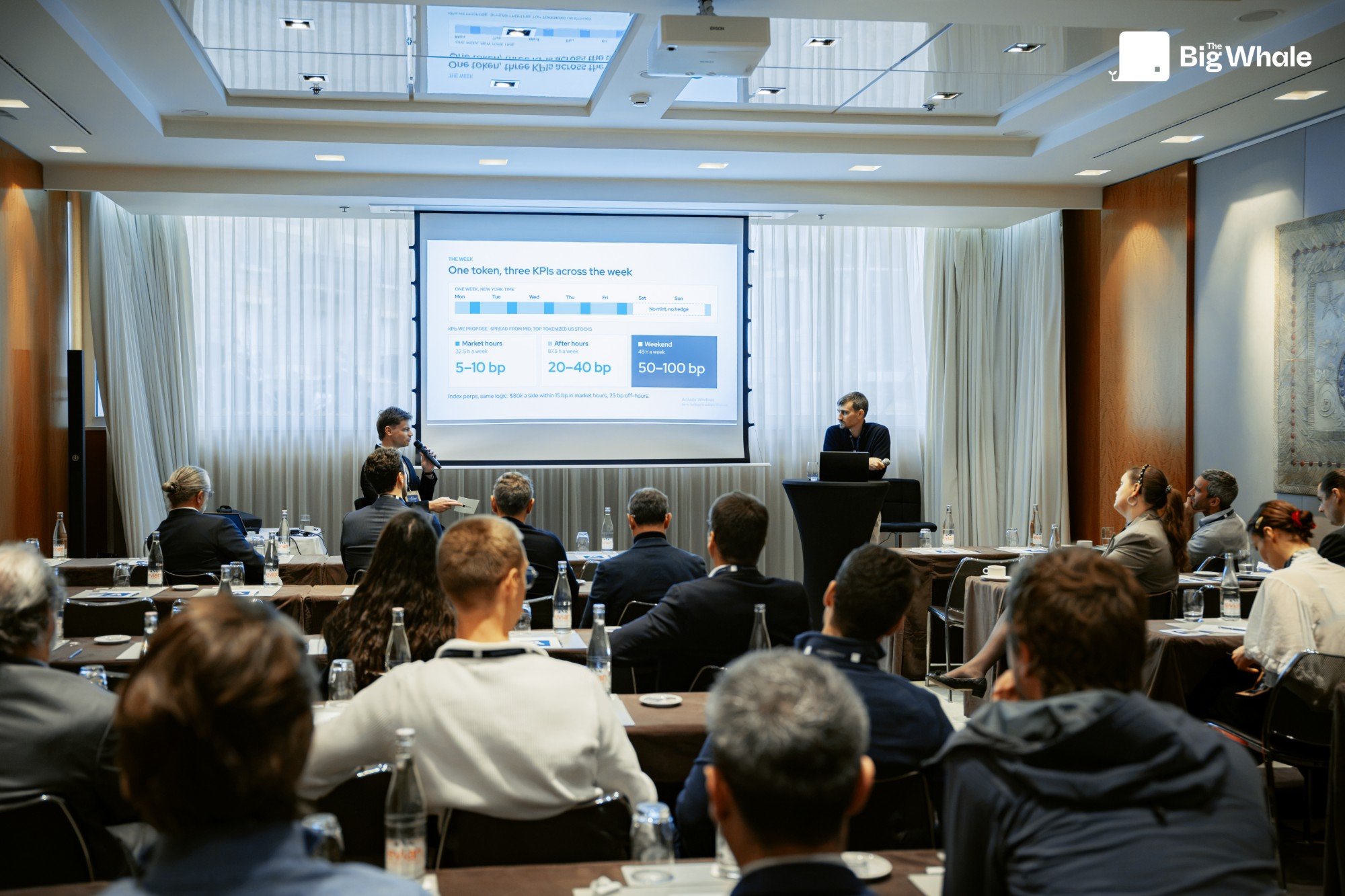
Using figures Flowdesk sees and quotes to clients, Guilhem Chaumont said getting exposure through a tokenized wrapper costs roughly 10 times more today. Spreads on the underlying majors are about 1 basis point, against 5 to 100 basis points on tokenized versions. On the most liquid tokenized stock, about $2 million sits within 2% either side of the mid price, an amount the underlying market offers at the bid or the ask. In Guilhem Chaumont's view the use case is already economically viable: 10 basis points is small for a long-term holder or for someone who wants to use the asset in DeFi.
- Mint and redeem runs five days a week. Some issuers have recently started offering it at weekends on a small number of assets.
- Flowdesk quotes clients three sets of targets: market hours, where it can be very competitive, after hours, which it can still manage, and weekends.
- At weekends a market maker can refill the book once or twice, then runs short. Big news on a large stock, such as a CEO resigning, would widen spreads sharply because the rails are not there yet.
- The SEC innovation exemption caps trading volume at 0.25% of daily volume, and Flowdesk was already hitting that limit on the Canton trade. Guilhem Chaumont called the rules reasonable, since in exchange they let non-regulated firms such as Flowdesk trade.
Why buyers accept the extra cost
A participant listed reasons for answering "no", including fragmented liquidity and the absence of wholesale markets, then asked why there is demand at all. Guilhem Chaumont gave three reasons:
- Distribution to retail investors who would never open a brokerage account. Guilhem Chaumont recalled a French statistic of 8% of people owning stocks against 30% owning crypto.
- Faster settlement for institutions. Saving two days saves a few basis points of funding, so an investor may prefer a 3 basis point spread on a tokenized asset to a 1 basis point spread at a broker.
- New uses in DeFi, the one Guilhem Chaumont is most enthusiastic about. With one partner, Flowdesk has a pool where holders deposit a tokenized S&P 500 and borrow dollars, in an open and competitive market. Flowdesk itself borrows tokenized assets for its inventory, in the single-digit millions today, instantly and with same-day repayment.
The same participant asked about directional flow. Guilhem Chaumont said the flow is far from buy and hold today: it is largely retail, getting in and out around earnings, with some people moving out of memecoins into stocks. Lending pools could encourage holders to keep their positions, and Guilhem Chaumont expects a pattern similar to ETFs, with more buyers than sellers probably for the next three years. Another participant asked whether retail would stay dominant. Guilhem Chaumont said that would be a failure for the industry, limiting tokenization to a "casino use case", and that the real value requires full institutional adoption.
Who can afford to make markets around the clock?
Asked whether tokenized assets cost more to operate, Guilhem Chaumont said the technology cost is the same, since these are ERC-20 tokens on known blockchains. The added cost is regulation. Flowdesk spent millions this year on it. When the firm was founded, five people with $1 million could start trading crypto; running a 24/7 operation with licences in at least three regions now costs between $50 million and $70 million a year. The Flowdesk CEO expects costs to fall as more participants arrive, and sees more risk in trading several versions of the same asset from different issuers than in trading USDT or USDC, because some versions hold the real share and pay dividends while others do not.
Another participant asked about competition from traditional trading firms. Guilhem Chaumont expects them all to come in and margins to compress, but said crypto is already very competitive, with 50 exchanges to cover. Flowdesk earns its margin as a client-facing firm, through issuer rebates and OTC: on a large block trade in a top-100 coin it might take 30 basis points, so an execution cost of 1 to 10 basis points matters little, and more competition lowers it. Asked by another participant about liquidity providers losing money, Guilhem Chaumont said some of the largest players accept losses on market making to see the flow, and Flowdesk does too in some cases.
On the October 10 crash, Guilhem Chaumont said extreme events come every three months in crypto. Flowdesk prices counterparty and operational risk and assigns credit ratings to exchanges. That event could not be anticipated, with assets trading at one cent or zero, and Flowdesk was protected by a conservative approach: no directional trading and no maximised leverage.
Which assets will stay hard to quote?
Guilhem Chaumont described three phases of tokenization: fiat through stablecoins, then assets already liquid in traditional finance, then illiquid assets.
- Tokenized stocks are relatively simple to quote outside the weekend gap, since they are regulated and less exposed to insider trading.
- Tokenized private credit funds or real estate will be very hard to quote, with spreads of 3% to 5% at first. Guilhem Chaumont said even a 200 basis point spread can be useful if it makes the asset liquid.
- Equity perpetuals work like Bitcoin perpetuals, with funding as the only difference. Flowdesk started quoting equity perpetuals before the tokenized stocks. It already trades some derivatives bilaterally on tokenized markets, and Guilhem Chaumont expects fully onchain structured products, such as a capital-guaranteed product buying options on tokenized equities, within two to three years.
- Tokenization is the least incentivized segment Flowdesk has seen. If issuer and exchange subsidies stopped, Guilhem Chaumont estimated that probably half of the volume would remain.
Asked whether tokenized assets will match the liquidity of Bitcoin or Ethereum, Guilhem Chaumont said the question is when. A company is easier to price than Bitcoin, and someone will always buy a stock at minus 20%, so the depth further down the book is real. The Flowdesk CEO put the timing at five to ten years, possibly a little faster with AI, although regulatory timelines will not compress. A participant asked whether trading on public blockchains affects spreads. Guilhem Chaumont said the effect on price is small, but confidentiality is probably the last technical issue standing in the way of full adoption.
What keeps banks on the sidelines?
Asked by the moderator what stops large banks and asset managers from allocating more, Guilhem Chaumont named three obstacles:
- They do not see the use case. When a bank does try it, the project usually sits with the innovation team, and the business lines are not pushing for it.
- Risk appetite: a large firm with a running business has to justify an onchain proof of concept.
- Counterparty standards. Banks want listed, certified and licensed counterparties, and Guilhem Chaumont estimated that 75% of the top 20 firms in the sector do not meet them.
Flowdesk operated under a simple AMF registration until last year. Guilhem Chaumont said MiCA is now stable and US requirements are clear (broker-dealer, money transmitter licences, swap dealer), so a firm can put $10 million to $20 million on the table for licences and capital, and broader adoption is a few months away. Asked by a participant about Citadel's opposition to equity perpetuals, Guilhem Chaumont predicted, or at least hoped, that incumbents would not be able to stop the trend, and said they are buying time while they build 24/7 operations.
Conclusion
In a second vote, the moderator asked whether anyone who had answered C now wanted to switch. Nobody did. Guilhem Chaumont said this was expected and pointed to the level of conviction in the room that tokenization is happening. The advice was to start with small trades and small amounts, avoid making PR out of it, and prepare for a high level of complexity, since the firms that win will be the ones that started early. Guilhem Chaumont also disclosed that Flowdesk took its subscription-based market making model to listed equities a year ago, with a few clients on a single venue and nothing tokenized, and said the firm might have to leave crypto for traditional finance if adoption does not happen.