


.jpeg)
Morpho Blue carries $10.86bn of TVL against $5.29bn borrowed, a utilisation of roughly 49% across the protocol. DefiLlama's headline TVL for this protocol is supplied liquidity. Adding borrowed amounts produces a deposit-plus-debt stock nearer $16.15bn. That is a different perimeter, not a second TVL.
A wider vault complex sits above that. S&P Global Ratings put deposits in crypto vaults at about $131bn in April 2026, up from $24bn three years earlier, with roughly 94% still in crypto-native activity: staking, crypto-backed lending and yield aggregation. That $131bn is not the curated lending-vault market. The slice that actually sets collateral, LTVs and caps, DefiLlama's Risk Curators category, was about $8bn in July 2026, with five curators controlling 80 to 82% of it (Steakhouse, Gauntlet, Sentora, K3 Capital, RockawayX, Hyperithm).
Underneath the label, three collateral families have formed, not two.
The first is digital-asset-native: wrapped and staked versions of blue-chip crypto (WBTC, cbBTC, wstETH, weETH). The second is cash-like on-chain collateral (sUSDS and similar). The third is real-world collateral: tokenised equities, tokenised money-market funds and treasuries, tokenised gold, tokenised private credit. Vaults price them differently.
The cleanest place to see it is inside a single book, where curator, chain, borrowed asset and date are held constant. Steakhouse's Prime USDT vault on Ethereum holds $74m across seven markets, every one of them lending USDT at almost identical utilisation.
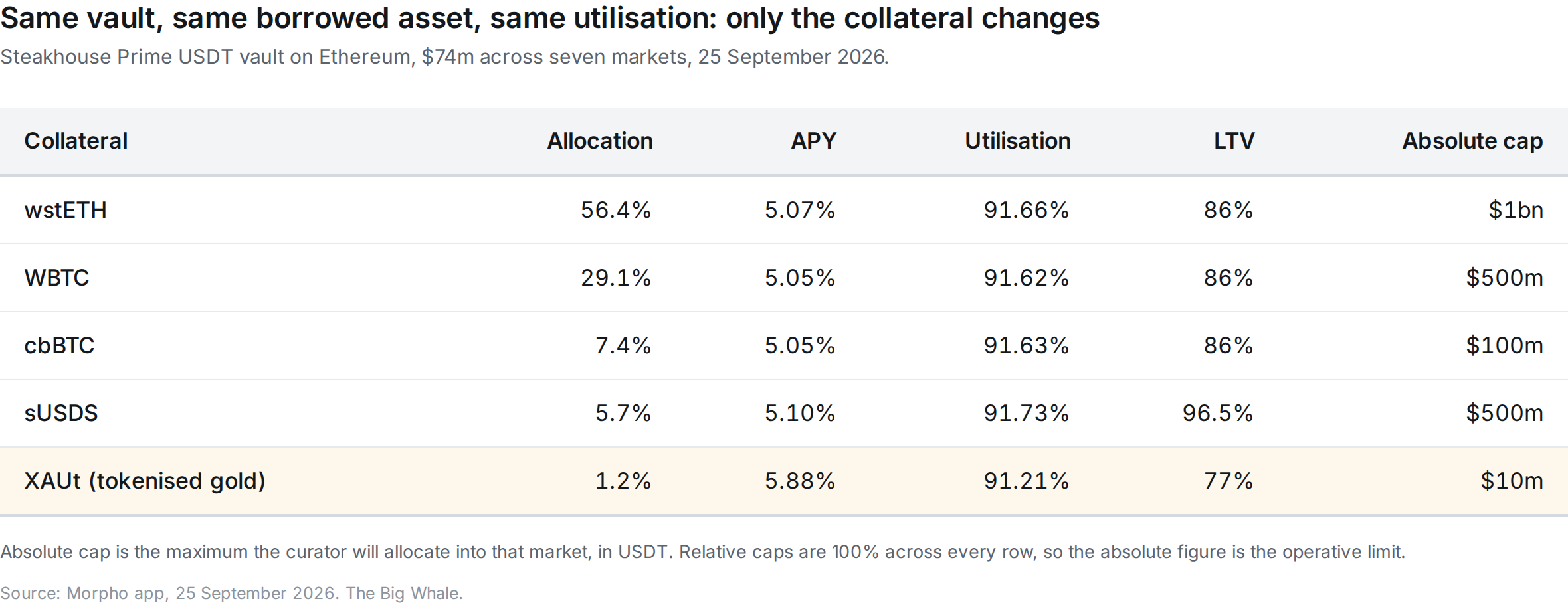
Tokenised gold pays 81 basis points more than staked ether at the same utilisation, and the curator haircuts it nine points harder on LTV. The caps say the rest. Steakhouse will lend up to $1bn against wstETH and up to $10m against tokenised gold, a ceiling two orders of magnitude tighter. Neither cap binds today, at $74m of vault assets and 1.2% in XAUt, so this is pre-committed appetite rather than an active constraint. That is one book on one day. It is the pricing mechanism, not yet a cross-market average.
sUSDS shows the third family: near-identical yield to blue-chip crypto, but a much higher LTV. The market treats it as cash-like, not as RWA.
Deposit growth is still uncertain. RockawayX's RWA USDC vault on Kamino, with 82% of its allocation in two real-world-asset markets, went from $24m to $78m in a month at 6.61% net APY and 90% utilisation, with no points programme. A Steakhouse vault with a 93% blue-chip book grew 27.6% over the same window. A larger blue-chip vault grew under 1%. On three vaults, growth ranked by size rather than by collateral. Worth watching, not yet worth asserting.
Why it matters for institutional allocators
The constraint is not what the collateral is worth. It is how much of it can be sold, and how fast it can be unwrapped, on the day a position has to close.
Wrapped Bitcoin (WBTC) alone carries $9.83bn, and that is one wrapper among several. Tokenised stocks are $5.48bn of distributed value. A single Bitcoin wrapper is therefore almost twice the size of the whole tokenised equity market. The two figures come from different providers on different bases, so treat this as scale, not a precise ratio.
That gap decides what a vault can safely do. A vault taking WBTC is lending against an asset with continuous global markets and buyers at three in the morning on a Sunday. A vault taking tokenised equities is lending against a distributed float of some $5bn that still trades against the clock of its underlying exchange. In a forced close, the first liquidates into a wall of bids. The second liquidates into whatever the on-chain venue holds.
Private credit makes the problem sharper still. It is the largest tokenised real-world category, at $26.03bn across the asset-backed credit bucket, and $23.71bn of that, some 91%, is a single token from one issuer: Figure's home-equity loan book. That is not a market. It is one securitisation programme that does not trade and does not appear as vault collateral. The headline number for tokenised private credit describes an issuance achievement, not a pool anyone can liquidate into. For tokenised gold and tokenised money-market funds the same clock matters in a milder form: oracle updates and redemption windows can be slower than the liquidation engine even when the off-chain asset is high quality.
This is where the vault-versus-fund distinction matters. Adrian Cachinero Vasiljevic of Steakhouse: "In a lending vault, the underlying asset isn't the collateral; it's a repayment obligation from the borrower. That obligation is secured by market incentives mediated by the smart contract: rates spiking when liquidity is low to force repayment, or the contract seizing and liquidating collateral to make the lender whole. So the quality of the asset is contingent on how fast the collateral can be liquidated."
An allocator running the usual credit checklist of issuer quality, rating and default history is checking the wrong column. Credit quality is second-order. Depth, and unwrap speed, on the day you need to sell is first-order.
The Big Whale's take
The premium is for liquidation latency, not credit risk. The 81 basis points tokenised gold pays over staked ether, in the same vault at the same utilisation, is that vault paying an allocator to accept collateral that cannot be sold quickly under stress. That can be a rational trade. It is not the trade most depositors think they are making, and no vault interface distinguishes the two families.
Low volatility is not low risk here, and that inverts a TradFi habit. Cachinero Vasiljevic: "It isn't only volatility that determines risk; it's liquidity and the speed of recovering that liquidity. An asset with lower volatility but much lower liquidity is riskier to a vault lender than Bitcoin, because it's harder to liquidate and repay."
A tokenised money-market fund can look safer than Bitcoin on every traditional metric and still be the worse collateral in a forced sale. Asset managers citing RWA volatility as the concern are arguing the wrong variable.
The honest read from the largest independent curator runs against the prevailing narrative, and he has every incentive to say the opposite:
In DeFi today, crypto is probably the best collateral; it liquidates fastest. It's limiting for borrower growth, because there's only so much you can borrow against Bitcoin, and I'd find it far more interesting to have diverse RWA classes on-chain. But until those assets are inherently more liquid, it's hard to break out of that.
The bottleneck he names is not appetite, regulation or tokenisation volume. It is secondary-market depth: "making real-world collateral as liquid on-chain as its off-chain counterpart."
So the metric to track is not tokenised market value, and it is not S&P's $131bn vault wrapper. It is tradeable depth inside the curated books that actually set caps. Tokenisation volume has grown regardless. What has not grown is the ability to sell those tokens quickly to a third party. Until it does, real-world collateral will keep earning its premium, and curators will keep pre-committing to far smaller maximums against it than against crypto. Those caps are a better guide to institutional readiness than any adoption figure.















%201.png)
%201.png)















%201.png)