

.png)
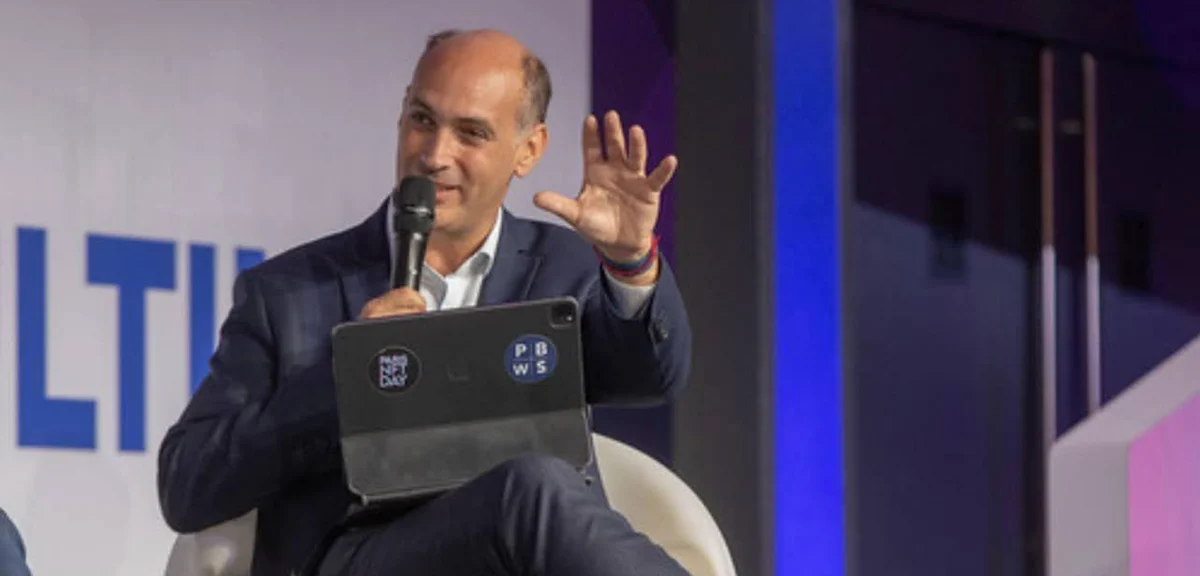
The Big Whale: PBW will be celebrating its 4th edition in March. What is the aim of such an event?
Michael Amar: Our aim is to bring together the Web3 ecosystem and move it forward. I remember that at the time of the first edition of PBW (in 2019, ed. note) not many people were working in blockchain and cryptos. Based on LinkedIn, there must have been a few hundred, maybe a few thousand people in France, no more!
Today, the ecosystem has grown a lot. There are thousands of sales people, engineers and developers working on these subjects, and that's felt right down to the companies we attract for the PBW.
That is?
For this new edition, we're going to have a record number of 'traditional' companies, almost as many as Web3 native companies. It's a real shift. We knew it would happen, but not necessarily so quickly.
How do you explain this change?
There are clearly two factors at play. First, the fact that it's been a very complicated year for the crypto sector, culminating in the fall of FTX. Many players have been affected. They've scaled back and are therefore participating less in events, particularly financially.
And the second point, which is directly linked to the first, is that nature abhors a vacuum: traditional companies, particularly Big Tech, have clearly seen that there is a place to be taken and are therefore more present.
As you said, the crypto sector is bearing the full brunt of the crisis. Isn't it complicated to organise an event like this in these conditions?
It's obviously not a favourable context. Organising an event like the PBW costs money, and sponsorship is very important. Excluding ticketing, it represents more than 50% of our budget, so the drop in investment from crypto players is having an impact.
Will you break even?
Yes, that's planned.
How?
Precisely thanks to new players like Google and other companies and brands, particularly in luxury. There are dozens of world-famous brands that will be present.
Don't you fear that by leaning on all these groups you are betraying the spirit of Web3 a little?
Not at all, in fact the opposite is true, in my opinion. In fact, things are quite simple: if we keep to ourselves, the Web3 ecosystem isn't going to develop, at least not fast enough.
What do the Web2 giants bring to the table?
A lot of things, and in particular the users. When Instagram gets into NFTs, potentially hundreds of millions of people can mine NFTs, own them, exchange them...
If I wanted to be a little prickly, I'd even say there's a certain form of hypocrisy in not wanting these big groups. Most crypto and Web3 projects work with the tech giants without perhaps even knowing it.
The reality is that if we want Web3 to develop, we have to go where the users are. It's an illusion to think that Web3 can be achieved without Web2 players. Web3 needs the Web2 players.
How will this year's event be organised? Have you adapted the event to these newcomers?
We haven't changed anything, but the event is more business-oriented. We're going to have a number of highlights, such as the "Talent Fair", which is a day dedicated to companies looking for Web3 profiles. There will be over 1,000 of them!"
Many companies want to get into cryptos, make a collection of NFTs, but it's not easy to know who to work with, how, why? We want to help them with that.
There will also be an investor day bringing together hundreds of players, investment funds, hedge funds, family offices, sovereign wealth funds, who are looking for projects to invest in. And of course we'll have conferences and a host of speakers including the boss of Reddit, the CEO of l'Oréal, the head of all things NFT at Meta, the de Solana teams...
Some people are complaining about the ticket prices, which are reaching several thousand euros. What do you say to them?
Yes, I understand, but we are an event dedicated to businesses, and we accept that. This year, we're at the Carrousel du Louvre, right in the heart of Paris, with people coming from all over the world.
All this comes at a cost, but you have to understand that it's a huge opportunity for businesses. For a few thousand euros, you can access investment funds, potential customers or partners, it's a real chance.
We're talking about Google, Meta, Reddit... Will there be enough French and European companies at the PBW?
Of course, we're counting on 20% French and more than half Europeans. There are few international events where the French are so well represented. But we should also be pleased that Paris is hosting so many global groups.
Don't you have the feeling that there are too many conferences?
I don't know, the conferences are very different: some are very technical, very focused on individuals. We're aiming for a more business-oriented audience made up of companies.
How many people are you expecting?
We're aiming for 10,000 people over the week, which would be almost twice as many as in 2022 (6,000, editor's note)!
What's your objective this year?
There should be business and Europe and France should shine. At our first event, we invited Binance and other major players, and we can see that all these players are now present in France. This is an excellent thing.













%201.png)
%201.png)












%201.png)