


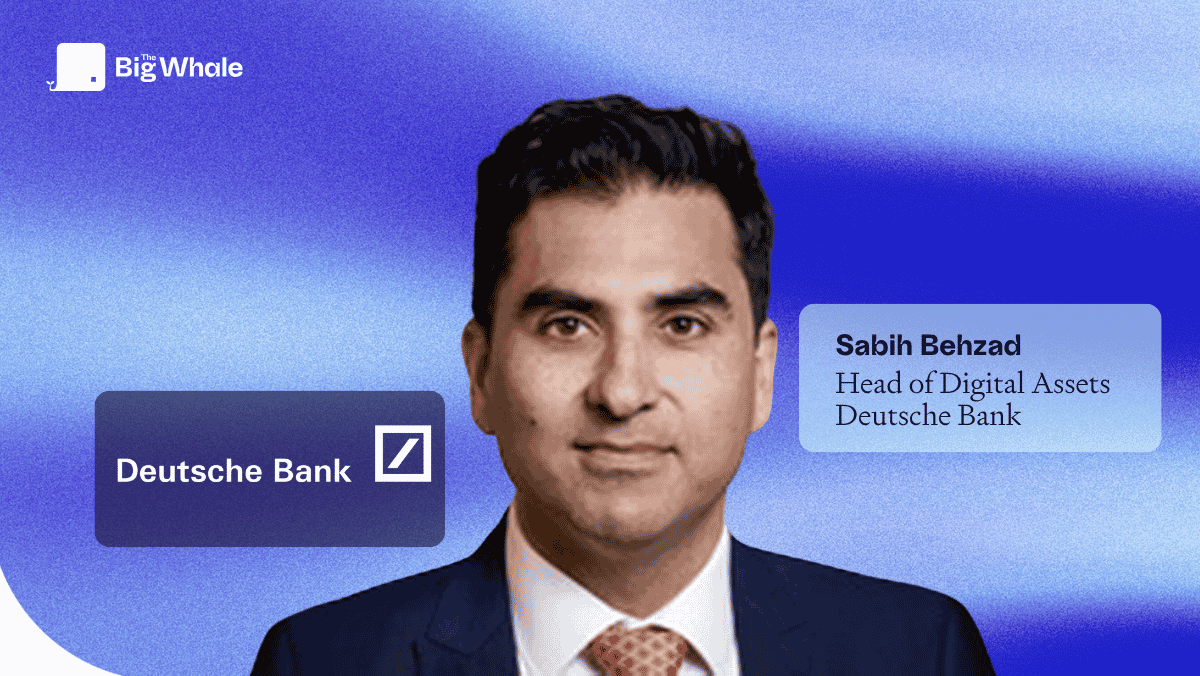
Germany is often cited as one of the most advanced markets in Europe for digital assets. How do you view the German ecosystem today?
It's a very healthy market, and that's down to several factors. First, there was a dynamic retail crypto market well before the tokenisation of financial securities. German retail investors have been familiar with these assets for a long time, which created a solid foundation. Then, regulation played a driving role: Germany had already put in place a national framework before MiCA, giving its players a head start. And you have to factor in the presence of major European banks on the ground (Deutsche Bank, but also Commerzbank and others) that are investing in the use of blockchain in traditional finance. Add to that the strength of the fintech ecosystem, particularly in Berlin, and you get a community that is genuinely innovating in digital assets.
A year and a half after MiCA came into force, euro stablecoins still represent only a tiny fraction of the global market. What's holding things back?
Let me turn the question around: what's propelling dollar stablecoins? Because that's where the key lies. The primary use case for stablecoins remains crypto trading, and crypto is entirely denominated in dollars. As long as that's the case, dollar stablecoins will dominate by default. Second point: the United States is actively encouraging stablecoin development. They say it publicly: it's a way of exporting American debt around the world. Europe, for its part, has taken a much more cautious approach. If you compare the yields that stablecoin issuers can generate in Europe versus the United States, the difference is stark (partly because of the regulatory architecture, partly because US Treasuries remain an incomparably deeper market).
Can the euro close the gap?
I don't believe euro stablecoins will win the battle in the crypto universe. We're not going to see new cryptocurrencies denominated in euros. The real unlock for Europe will be institutional adoption and real-world use cases: cross-border payments, corporate finance. We're seeing the first signals, but the question is whether it can scale. The other difficulty is the proliferation of solutions in Europe: digital euro, EPI, tokenised deposits, stablecoins... Where the United States has bet massively on the stablecoin as the dominant form of digital money, Europe is spreading its efforts thin.
On that point, how do you see the coexistence between private stablecoins and central bank digital currency?
First, an important clarification: central banks do not issue stablecoins. A stablecoin is by definition the liability of a private issuer. The real question is the comparison between stablecoins and retail CBDCs, and we need to stop lumping them together. Virtually all retail CBDCs are domestic instruments, not cross-border ones. A stablecoin is the opposite: its real superpower is cross-border. In most developed countries, instant payment systems already work very well (near-free, 24/7, with settlement in a matter of seconds). The stablecoin doesn't win on that front. But as soon as there's a cross-border dimension, it holds its own, because it crosses time zones and settles almost instantly.
But then, is there room for both?
Yes, because the intent behind each instrument is fundamentally different. The digital euro, if and when it arrives, will be the equivalent of a banknote in a digital context. If tomorrow you no longer trust your bank, you withdraw your cash and put it under the mattress. The digital euro will offer the same option in the digital world: converting your money into central bank money. There will probably be caps. Central banks aren't doing this for mass adoption, but to offer an option (a form of optionality). The stablecoin, on the other hand, is built on a specific commercial model. No private company launches a stablecoin for the public good: it does so to generate a return, and it wants you and me to use it. These are two completely different logics.
JP Morgan, Citi, and Bank of America have announced a joint tokenised deposit project via TCH. Where does Germany stand on this front?
A clarification first: that announcement came from TCH, the US clearing house, of which Deutsche Bank is also a member. We weren't named specifically, but we are de facto stakeholders. And some European banks are too (a point that was largely overlooked in the media coverage). In Germany, there is the CBMT initiative (Commercial Bank Money Token), which is trying to bring German banks together around tokenised deposits
Tokenised deposits versus stablecoins: which one wins?
These instruments are complementary. I like the stock-and-flow framework. For flow (cross-border payments), stablecoins are very effective. But for stock, especially for institutional clients, the money needs to be converted back into deposits. Tokenised deposits allow that. In the short and medium term, the two will coexist. Nobody really knows what the long term will bring.
If you had to place a bet today for Deutsche Bank: what's the bigger revenue line in three years, stablecoins or tokenised deposits?
That's hard to answer at this stage. What I can say is that stablecoins already exist and are real. Volumes remain modest by the standards of a bank like Deutsche Bank, but we have clients who use them or want to use them in their flows. Facilitating those movements could certainly constitute a business model. We're also developing a digital asset custody capability (not just for crypto, but also for stablecoins). There's clearly a business case there. For tokenised deposits, the monetisation remains unclear. Even JPMorgan, which processes significant volume, hasn't yet clarified the model: is it a replacement of traditional rails with no cost differential? Or is it a fast lane on which you pay a toll? The main question that still needs to be answered is one of interoperability of tokenised deposit solutions across banks.
Qivalis, the euro-stablecoin consortium, now has 37 banks. Deutsche Bank is not among them. Why is Germany's largest bank absent?
Our stablecoin strategy continues to evolve. This is a new and emerging space. The real strength of the stablecoin is cross-border, and for that, you need sufficient regulatory clarity in the jurisdictions where you'd want to use it. We're constantly evaluating the various consortium structures. We're not closing any doors, but at this stage, we're indeed not in Qivalis. However, we do participate in the Faro consortium, which brings together several of the world's largest banks (including BNP Paribas, Crédit Agricole, Bank of America, Citi, Santander) around a stablecoin backed by G7 currencies, with a primarily dollar orientation.
DWS, the group's asset management arm, has invested in AllUnity, which issues the EURAU stablecoin. So Deutsche Bank already has a foot in the euro stablecoin market?
Technically, DWS is a separate company. I don't have direct responsibility over their activities. But it is indeed a group entity, and to the extent possible, we coordinate our approaches. So yes, Deutsche Bank already has a presence in the euro stablecoin market through its stake in AllUnity. Their strategy is the right one: penetrating concrete use cases, especially cross-border payments. The question is how far they can go, because no single company can drive stablecoin adoption on its own. The entire ecosystem needs to develop in parallel, starting with integration into ERP systems like SAP, from which the majority of corporate payments originate today.
You completed your first cross-border euro payment on the Partior blockchain in September 2025. What volumes are you processing on the platform today?
That was a test transaction designed to demonstrate our operational capability. I wouldn't draw any conclusions about volumes from it. But Partior is one platform among others: there's also Project Agora, Swift Ledger, and other similar initiatives. What matters is having the ability to connect to these different liquidity venues. We're not pushing a single channel. The fundamental principle is having the capacity to interact with markets wherever liquidity emerges.
Clarisse Hagège, CEO of Dfns, stated at our breakfast in Amsterdam that correspondent banking could disappear within five years. Do you share that view?
That's a very aggressive prediction. The core of correspondent banking is that a few banks have RTGS access within individual jurisdictions and provide that service to those that don't. I don't see central banks opening up that access on a broad scale any time soon. The other implicit assumption is that the stablecoin could fulfil the same function. But we come back to the question of risk and the form of money. There's also a misconception that all cross-border flows are slow and expensive. The data shows the opposite: the vast majority of flows are actually fast and inexpensive. The problem is concentrated on certain corridors, particularly towards emerging markets, where the banking rails aren't developed enough. That's where stablecoins have genuine legitimacy. And then there's counterparty risk: are you prepared to accept the credit risk of an institution that has only existed for a few years and promises you that its reserves are high-quality liquid assets? These are serious questions.
Let's turn to DAMA 2, your public-permissioned layer 2 on ZKsync. What does a public blockchain offer that a fully permissioned ledger cannot?
Several things. First, the speed of development and the richness of the ecosystem. I compare it to open source: you can develop bespoke software that works well, but open source will beat you almost every time because it evolves, improves, and gives you access to an incomparably larger pool of developers. Then, the distinction between assets and money is already dissolving. Tokenised money market funds are being used as cash. Tomorrow, in a digital wallet, you'll have tokenised bonds, equities, stablecoins, tokenised deposits, and you'll want all of them to interact. On a closed private chain, that's difficult: you can only use it for one or two use cases. You have to think in terms of marketplaces: public chains are open markets where everyone can come and sell their goods and services. If you want to sell, you go where the people are, not to your garage.
And the Internet analogy?
Exactly. We don't each have our own Internet. There's one, and then everyone builds their walled gardens to protect certain data. But what makes the Internet work is that we're all connected to it. It's the same logic for blockchain.
Are you optimistic about collateral tokenisation?
The potential is real. Collateral movement today is slow, expensive, prone to errors and timing mismatches. If blockchain can improve that, it will be welcomed. But we're still at the beginning: there are eligibility questions around collateral to resolve. The ECB recently authorised tokenised collateral via CSDs, but the rules and accounting practices still need to be developed. Exchanges and clearing houses also need to be on board, and that seems to be starting.
Where do you stand on the launch of your digital asset custody offering?
We haven't launched yet.). The considerations for a large bank like ours are numerous: which technical model to adopt, how far to internalise security versus relying on an external provider, which regions to cover, which assets to support (crypto only, MiFID instruments, or both). Choosing the right technology partner is also critical.
Circle is launching its "agent stack", AI-agent payments in stablecoins are multiplying. Where does a bank like Deutsche Bank position itself in this emerging ecosystem?
These are developments we're watching very closely. We're in constant dialogue with our clients about use cases. We're a client-driven organisation: if demand moves in that direction, we'll follow. These spaces are still very experimental. For most banks, the number one priority remains keeping the existing infrastructure running. But we do collaborate with players in this ecosystem. For example, we were advisers on Circle's Arc platform. We're not looking to be disintermediated, but rather to work with partners to develop our own products or collaborate where it makes sense.
MiCA is in place, the GENIUS Act has been passed, the Clarity Act is advancing. What regulatory or market change would truly unlock institutional volumes?
To achieve volume and scale, the large banks and major institutional players need to be fully engaged, because they're the ones with the balance sheet, the connectivity, and the ability to move the needle. For those players to move at pace, you need a viable commercial model. And the main obstacle to that model is the lack of regulatory harmonisation. I'm not talking about a single global regulation (that doesn't exist for anything today), but about common principles. For instance, prudential treatment: it's inconsistent that in Europe a crypto-asset is treated as an intangible asset with a certain risk weighting, while in the United States it's treated as a cash equivalent. That disparity prevents banks from building global business models. The day those principles are aligned, banks will be able to develop activities at scale, and we'll see a genuine acceleration.
What's your realistic horizon for this transformation?
It won't be a big bang, but a process. Regulators' understanding has improved considerably in recent years. And US pressure is forcing everyone to speed up the thinking. But I'd say the migration will unfold over the next five to fifteen years. Some things will come quickly, others will take time. Digitally native companies (fintechs, crypto-native firms) will adopt first. They want everything on-chain: their treasury in stablecoins, their bond issuances on blockchain. For a large industrial group with legacy infrastructure, it's different. The wave of innovation will be led by digital natives, and then large corporates will replicate where it's relevant. And one day, we'll stop talking about digital assets, because they'll simply be... assets. The fact that it runs on a blockchain, nobody will care. It will just be available 24/7, fast, and inexpensive.














%201.png)
%201.png)















%201.png)