

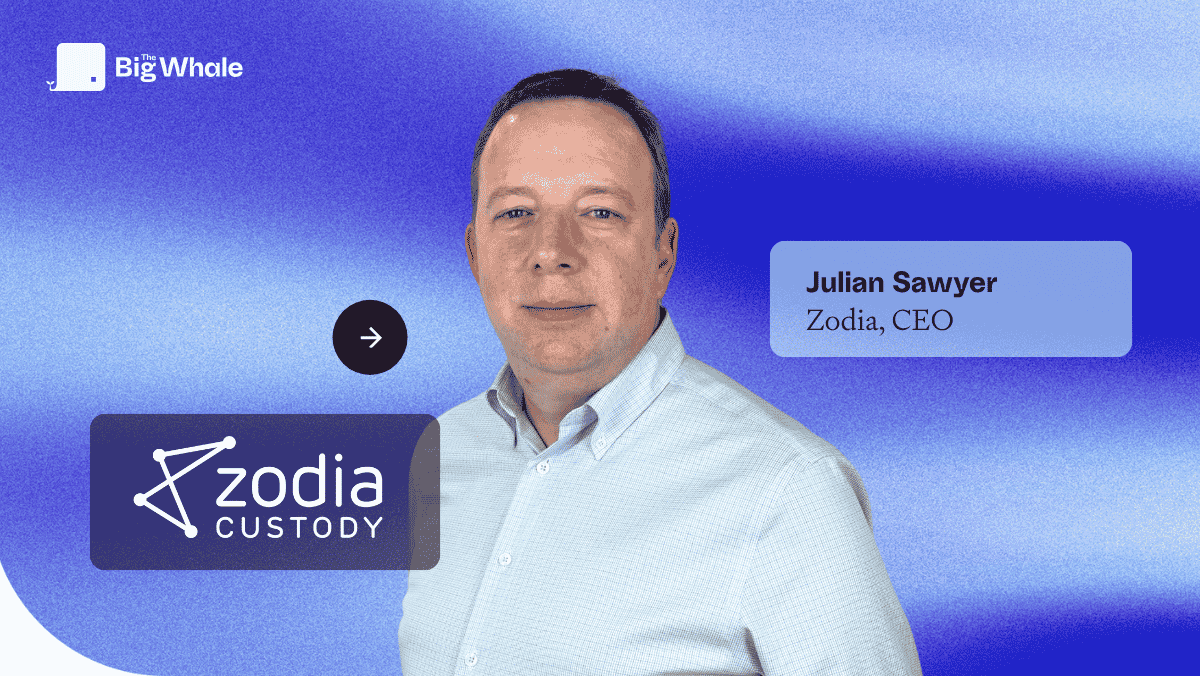
Standard Chartered just announced the acquisition of Zodia Custody. We hear about Zodia Custody, Zodia Markets, Zodia Solutions. Can you walk us through what each of these entities actually does?
Zodia Custody was the first entity created by SC Ventures. Zodia Markets is a separate business with different shareholders, focused on OTC trading. Zodia Solutions is a spin-out from Zodia Custody. What we've announced is that Standard Chartered will acquire the regulated side of Zodia Custody — our operations in the UK, Luxembourg, the Middle East, Asia, and Australia. At the same time, we're carving out the software layer under the Zodia Solutions brand, which becomes an institutional infrastructure platform.
Two simultaneous moves, then. Why now?
Because two structural trends are converging. First, custody is migrating toward banks. Standard Chartered is the first bank to take that step through an acquisition. That sends a very strong signal to the market. Second, our software-as-a-service business has accelerated considerably over the past twelve months. More and more banks are coming to us because they want to hold digital assets — stablecoins, tokens, crypto — and they need banking-grade software to do it. Their options are limited: build in-house, buy software, or rely on a third-party custodian. When you're buying software that powers Standard Chartered and a whole roster of other banks and financial institutions, that's a pretty compelling sales pitch.
Month after month, we're watching banks bring custody in-house. Be straight with me: what's left for crypto-native custodians?
I'm not going to give you a yes-or-no answer, because the reality is more nuanced than that. If you bring custody in-house, you have to cover the full spectrum of assets. And odds are, your risk appetite caps you at the top ten or twenty tokens. What happens when a client shows up with the twenty-fifth or the hundredth token in their portfolio? You turn them away. Layer the geographic dimension on top of that: digital assets operate 24/7, globally. You don't necessarily have the regulatory approvals to operate in every jurisdiction. So there can be very concrete reasons to use a sub-custodian.
And the second dimension?
The pace of change. This market moves at breakneck speed. Things we're discussing in May 2026 didn't exist twelve months ago. Take Canton Network — relatively new, and overnight, we all had to support it. We were the first bank-backed custodian to integrate it. For banks, which aren't always the fastest movers when it comes to innovation, that's a massive challenge. By providing our software, we can switch on those capabilities far more quickly. Their systems get updated the way Apple updates your phone: you get the latest widget without lifting a finger.
Copper, meanwhile, is looking for a buyer after shutting down its institutional custody business in 2023. Between this acquisition and the Copper example, is the crypto-native institutional custody market dying?
Crypto-native custodians will have to pivot. There will always be a need to serve crypto-native companies with crypto-native custodians. The question is whether that's a big enough market — growing, exciting. I have my doubts. If you look at where the capital sits, where the institutions are, the answer is clear: you need the right level of risk management, compliance, legal controls. Copper is struggling. Other custodians are too. This will be a recurring theme in the months ahead.
"Your assets stay in custody — you don't pre-fund the exchange"
Let's talk about Interchange, your off-exchange settlement product. How does it actually work?
Interchange is an off-venue settlement product. We have exchanges like Deribit, Bybit, and BitMEX connected to it. As a client, you keep your assets with a Zodia Solutions custodian — typically Standard Chartered. You don't need to pre-fund your account on the exchange to trade. You eliminate counterparty risk with the exchange. Everything stays with the custodian.
Hypothetical question: in a stress scenario, if a counterparty defaults mid-settlement, what happens?
Interchange isn't just a piece of technology — it's also a legal construct, and a lot of people miss that. First, your assets are held in trust at the custodian — at Standard Chartered, for example. They're not the bank's assets, they're not ours, they're yours. The tripartite control agreement between the client, the exchange, and the custodian covers every scenario: the client goes bankrupt but the trade has been executed; the exchange fails and assets are locked; or the custodian itself defaults. In each case, there are legal and technical mechanisms to ensure the counterparty can recover its assets, its fees, and complete the transaction under the best possible conditions.
What's the business model for Interchange?
It's a usage-based billing model. Today we have two components: the software and the custody activity. Once Standard Chartered absorbs the custody piece, we'll be purely a technology provider for the ecosystem. Interchange will become one product or feature among others that we offer. Zodia Solutions, as an unregulated, pure-software entity, can operate with the cost structure and operating model of a pure infrastructure vendor.
"Custody is the foundation. The differentiator is regulation, speed, and risk appetite"
Back to the acquisition. Standard Chartered launched its own custody operation in Luxembourg in January 2025. Was your acquisition strategic consolidation or overlap?
Standard Chartered announced as early as 2023 that it was entering digital asset custody — first in Dubai, then Hong Kong, then Luxembourg — all built on our technology stack. So this is genuinely a merger between Zodia Custody and the bank's digital custody operation, designed to bring scale, a consistent client experience, and market clarity. We've been providing technology services to Standard Chartered and other banks for three years. As the market has matured and tokenization and stablecoins have gained momentum, there's a lot more energy behind asserting this proposition and showing how it can reshape the sector.
You sell infrastructure to banks so they can launch their own custody. Every client you onboard could become a Standard Chartered competitor. How do you manage that tension?
If you look at traditional banking, that scenario plays out everywhere. BlackRock built Aladdin, and you can find plenty of similar examples. Custody is the foundation. It's not the differentiator. The differentiator is the regulatory wrapper, speed to market, risk appetite, the associated products. If you need to hold stablecoin, you need a platform for that. Whether it's this platform or another one isn't what sets you apart.
Does Zodia have a presence in the US?
Zodia Custody doesn't have a US presence. I can't speak to what Standard Chartered will do with the custody business, since they own it now. On the Zodia Solutions side, Northern Trust is one of our shareholders and a US-based custodian. We'll sell to American organizations just as we sell across Europe, the Middle East, and Asia. Our technology is a global product.
"You either become the standard or you hit a dead end"
We've seen a lot of consolidation in prime brokerage — Ripple acquiring Hidden Road, Coinbase buying Deribit. Does Interchange gain value as a neutral layer? Or do you risk getting crushed by players vertically integrating their own infrastructure?
Both are true. In the short term, there's genuine demand for independent trust arrangements, account control agreements, counterparty risk management. Some players will be more vertically integrated, and that may work for them. But over the longer term, market structure will evolve. This isn't the final state for the next forty years. What happens in financial services is that you need standards, consistency in how things are applied, and then consolidation. Someone will end up owning the standards and growing into the dominant provider of a given capability. We're working very hard to be that standard, that independent reference infrastructure. And it all comes back to flexibility: you have to look 12, 24, 36 months ahead and understand where the market is going, which bets to place, what optionality to build into your systems, your shareholder structure, your cap table. Otherwise, you hit a dead end.
Last question. Three years from now, banks are running custody, settlement networks are operational, regulation is in place. What does Zodia Solutions look like? And what's the scenario where it doesn't work?
The positive scenario is that Zodia Solutions becomes the go-to banking platform for everything related to digital assets. A dominant player — or at the very least, a very strong one. The downside scenario is a regulatory slowdown or a market pullback. The need is there, no question about it. Every bank will need this capability. But the timing isn't in our hands. It depends on market dynamics, regulation, and competitive forces. And that timing will determine everything.
>> Gerry Afentakis (Zodia Custody): "Asset custody is the cornerstone of digital finance"














%201.png)
%201.png)














%201.png)