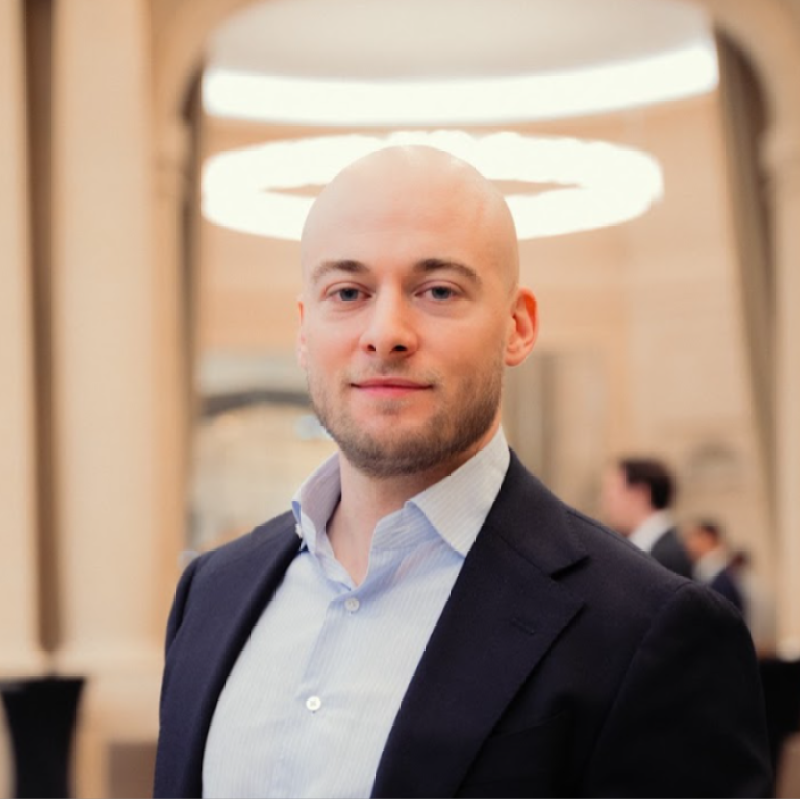
Paolo Ardoino (Tether): "Nobody in Europe or the United States really needs a stablecoin".
Ask AI TO SUMMARIZE ThIS ARTICLE

While in Paris for Paris Blockchain Week, the emblematic CEO of Tether Paolo Ardoino (also CTO of the Bitfinex exchange platform) gave a lengthy interview to The Big Whale. He details the group's strategy and explains why it does not want to be regulated in Europe.

Your 2 free articles this month are up

The research your peers are already leveraging

The Big Whale gives financial institutions the market intelligence, network, and platform to move with confidence in digital assets. Trusted by 150+ firms.

The Big Whale: The start of the year was marked by the arrival of ETF Spot Bitcoin. How do you rate this event?

Paolo Ardoino: In terms of recognition from traditional finance, the arrival of Bitcoin Spot ETFs is the most important event the sector could have hoped for. Especially since, according to BlackRock CEO Larry Fink, most of the demand is coming from retail clients at the moment.

You know the famous saying, "First they ignore you, then they laugh at you and attack you, before they accept you". I think we're now at the acceptance stage.

On the other hand, this is not good news for self-custody, one of the major advantages provided by Bitcoin. Especially as Coinbase currently captures almost 90% of the market for the custody of assets held in these ETFs. Even though we are campaigning for bitcoin to be adopted by as many people as possible, we don't think it's healthy to reduce the appeal of self-custody.

It's still very positive for the institutionalisation of the sector.

It's obviously an easier way for traditional players to buy bitcoin and diversify their portfolios. Instead of buying gold ETFs, they can now buy bitcoin via ETFs. In particular, this opens the door to pension funds, which are among the biggest holders of cash in the world. When they start doing this on a sustained basis, we will see a significant increase in the price. I think it will take between two and four years to get going.

Is this having an impact on your Bitfinex exchange platform? Are you working with more companies?

This is great news for us as our volumes have increased significantly. The buying demand for bitcoin ETFs will continue to grow, forcing market makers to seek liquidity from all over the world, including Bitfinex.

Bitfinex has a very important role to play as we have the most liquid order book in the bitcoin market. We currently hold nearly 15,000 bitcoins (around $1 billion at the current price, editor's note) while Binance, one of our main competitors, only holds around 2,300 ($159 million). This shows that the big carriers are turning to us instead.

We are also working on a tokenisation platform. Our aim is to be at the centre of a $10 trillion-plus market that will emerge in connection with the widespread tokenisation of assets.

How many Bitfinex customers does it have?

Today, we have nearly 5 million customers. That's far fewer than Binance (170 million claimed, editor's note), but Bitfinex wants to go in a different direction to most other exchange platforms. We are targeting more professional users such as traders and institutional investors. For them, we want to simplify access to bitcoin liquidity. We're not really geared towards individuals.

Which parts of the world do your customers come from?

They are mostly Asian, from the Middle East and located in historic offshore territories such as the British Virgin Islands or the Bahamas. We have virtually no presence in Europe.

Actually, the implementation of MiCA (the European regulation that will govern crypto) is approaching. You have not yet taken any steps to regulate Bitfinex and the stablecoins issued by Tether, are you giving up on Europe?

Effectively, because I am rather pessimistic about the development of crypto in Europe.

Why?

Firstly, I would like to make it clear that we are in favour of regulation in general. We are seeking to obtain licences more or less everywhere in the world.

As far as Europe is concerned, I don't think MiCA can encourage the emergence of a welcoming regulatory framework. Clearly, the message being sent is that Europe does not want crypto with regulation that largely limits access to it, especially for retail investors.

This is understandable because Europe needs to protect the euro, and it has to be said that stablecoins in dollars are crushing the market, even in Europe. That's why Europe has put in place very restrictive measures on stablecoins.

What do you think Europe should do?

Simply establish regulation to attract crypto companies. Instead, Europe is desperately trying to fight an inexorable wave of adoption. Just take the debate around Central Bank Digital Currency (CBDC). Whether it's the Republicans or the Democrats in the US, nobody is arguing in favour of setting up a MNBC. In Europe, the opposite is true!

From my point of view, this is something very worrying about the state of freedoms on the continent that is nevertheless the cradle of them. In my view, Europe is rushing to regulate with the risk of stifling innovation. The other example is artificial intelligence, which Europe already wants to start regulating even though no one really knows yet where it will all go!

But there is a logic to this way of doing things. On crypto, I've spoken to many European regulators and from my point of view, few really understand the underlying technology.

So in your view, because Europe doesn't have a currency as influential as the dollar, it should open its arms to the "crypto revolution"?

It should put in place regulations that are more understanding and favourable to the development of the crypto ecosystem. In this sense, the example of stablecoins is striking.

At Tether, what particularly bothers us about this specific part of MiCA are the very strong constraints on how you can manage your reserves. If you are a small stablecoin issuer, 30% of your reserves must consist of cash deposits at a bank. In the case of stablecoins of systemic size like ours, this requirement rises to 60%!

These are particularly difficult requirements to meet for stablecoins that have to be very flexible to repay users who request it. In 2022, we had to repay almost $7 billion in less than 48 hours. In one month, the amount of these repayments reached 20 billion dollars, or a quarter of our reserves. This would have been virtually impossible to achieve so quickly if we had a quota of deposits tied up in banks.

Depositing cash with a banking player also exposes stablecoins to the risk of bankruptcy. Look at what happened in the United States with Silicon Valley Bank. The only way to protect yourself is to buy financial securities such as US Treasury bonds. In this case, even if the bank goes bankrupt, you are guaranteed to get your assets back.

But the constraints don't stop there. If a stablecoin wants to fit into MiCA studs, it must also spread its cash deposits across several banking players, at least six in the most favourable case and a dozen in the least favourable. Very few banks accept this type of business in Europe, it's already very difficult to get just one!

To sum up, then, you don't plan to be regulated in Europe in the medium term?

Not for the moment.

Six months ago, you were promoted to CEO of Tether, in addition to being CTO of Bitfinex. How do you explain this promotion?

I've been a very active member of the company for a long time and, as time has gone by, I've been able to promote my strategic vision for the group.

What is your strategic vision?

We want to build a group that promotes freedom of expression and financial freedom. The general idea is therefore to offer alternative solutions to existing monopolies.

This is what we are doing with the stablecoin USDT and Bitfinex, which offer an alternative model to banks and the large traditional markets for raising capital or making payments. But we intend to go further and are looking at artificial intelligence (AI), through our investment in Northern Data, which is a company that specialises in building AI infrastructures.

The idea is to provide an alternative solution that is not controlled by Google or Microsoft. In this sense, we have already invested nearly a billion dollars in AI, in particular to acquire GPU computer chips.

The reasoning is the same as for our investments in bitcoin mining. We want to avoid the mining market being used solely to feed bitcoin ETFs. It is to serve this overall ambition that we will continue to increase our excess reserves and investments in the areas I mentioned to serve our philosophy.

Tether announced record profits in 2023 ($6.2 billion), do you expect to go even further in 2024?

We expect even more profits in 2024. For the simple reason that our success can be explained by the fact that the global economy is heading straight for the wall.

The reason why the USDT has posted an increase in its capitalisation of almost $20 billion over the last four months is because more and more countries are desperately in need of dollars as their economies continue to deteriorate. This situation is forcing the United States to print ever more dollars, which mechanically benefits us.

How do you explain that the USDC, the stablecoin of your main competitor Circle, is not showing the same growth as the USDT?

Because they haven't understood who needs a stablecoin the most. Circle is mainly targeting its stablecoin at banks, when they don't need it. It's like selling ice cream to an Eskimo.

Nobody in Europe or the US really needs a stablecoin, most people living in those territories already have a bank account. Those who really need them are in Asia, the Middle East, Africa, South and Central America: all regions of the world that have difficulty accessing the banking system. More and more people are using our stablecoin to protect themselves from the collapse of their local economy.

Your reserve is mainly made up of US Treasury bonds that yield around 5% a year. Have you anticipated the impact of a future rate cut on your business?

Rate cuts won't be a problem because, in our view, they won't exceed 1% in the short term. Even with a yield of 3% or 4% a year, we will still be in a very favourable position. Inflation around the world is still very high. I've seen it for myself: prices are much higher in Paris than they were last year.

So it could be said that you are profiting from the worsening economy?

We are the twentieth largest holder of US Treasuries in the world. If we didn't, someone else would. And we're using it to build something useful for people in an uncertain economic environment.

More and more stablecoins are offering to share the return generated by the reserve with their users. Do you plan to introduce mechanisms of this type?

I understand this trend. It allows certain players to stand out from the competition. But we don't intend to do the same, mainly for regulatory reasons.

Wanting to hold a stablecoin with the expectation of getting some kind of return on it can be very much like a financial security. We have seen that the Securities and Exchange Commission (SEC) can be aggressive about this. Today, nearly 300 million people use USDT and we don't want to put them at risk.

In the past, we have often been accused of having too risky a strategy when it comes to managing USDT. Distributing the return to our users would add complexity to the structure of our product and we want to keep it as simple as possible.

In January, we interviewed Mark Karpelès, the former boss of the Mt. Gox exchange platform (which disappeared after a hack in 2014) who has plans to launch a rating agency dedicated to the crypto sector. He has stated that he wants to investigate Tether. What do you think about this?

One of the reasons for our success is that we are one of the most closely watched companies on the market, which means we have to make no mistakes! I wish Mark luck with his poetic project (laughs).

BlackRock recently launched a tokenised money fund on Ethereum, "BUIDL", which holds US Treasury bonds. Could you use these assets in the Tether pool?

As far as we're concerned, that wouldn't be very useful. We already have a very good partner in Cantor Fitzgerald, which is one of the 24 companies authorised to deal with the US Federal Reserve (FED). Incorporating BUIDL makes sense for some crypto companies, but not for us.

What's the status of El Salvador's "Volcano Bonds" project (sovereign bonds that can be bought in bitcoin) that you're supporting with Bitfinex?

The project is progressing well. There is more interest than last year. It's also interesting that El Salvador itself isn't rushing things because they're not in desperate need of funding at the moment. I think we'll see the first issues of Volcano Bonds during the course of this year.

People in the article
Louis Tellier

Louis Tellier is Lead Institutional Research at Blockstories, where he focuses on developing the institutional offering for digital assets. He joined Blockstories in April 2025. Blockstories was founded in 2022 and is headquartered in Berlin, with presence in France and Switzerland.

Prior to joining Blockstories, Tellier worked as a crypto journalist at The Big Whale from August 2023 to January 2025, covering crypto and blockchain topics. Before that, he was a journalist at L'AGEFI from May 2022 to July 2023, specialising in cryptocurrencies. Earlier in his career, he worked as a web and video journalist at BFM Business and as a video journalist at Le Figaro. He also taught journalism at IICP in Paris for three and a half years, with a focus on web video journalism. Tellier is a graduate of Sciences Po Grenoble and the University of Lille.

See all articles ↗
Raphaël Bloch

Raphaël Bloch is CEO and co-founder of The Big Whale, an independent market intelligence platform on digital assets serving financial market participants through editorial coverage, research, a weekly briefing, and in-person events. He co-founded The Big Whale in April 2022. At the platform, he moderates and hosts institutional events bringing together banks, asset managers, custodians, and infrastructure providers on topics including staking, on-chain yield, stablecoins, DeFi lending, and tokenisation. He has moderated panels at events hosted in partnership with Bitwise, Everstake, Gemini, Morpho, Hexarq, Coinhouse, Delubac, Franklin Templeton, and the Ethereum Foundation, held in London and Paris between late 2025 and mid-2026.

Before founding The Big Whale, Bloch worked as a reporter at Les Echos from December 2016 to March 2020, then at L'Express from March 2020 to March 2022. He also previously worked at Reuters. Since September 2022, he has held a concurrent role as Business Analyst at BFM Business. He has been active in crypto journalism since 2016. He holds degrees from emlyon and the CFJ.

See all articles ↗
Grégory Raymond

Grégory Raymond is Head of Research and co-founder of The Big Whale. A specialist at the intersection of traditional finance and digital assets, he has been covering the regulatory, institutional and technological developments of the sector since 2017 for an audience of decision-makers: ,banks, asset managers and fintechs. He is also the author of Bitcoin & Cryptos: L'enjeu du siècle (Talent Éditions, 2025), a book built around interviews with key figures from the ecosystem.
See all articles ↗
Subscribe to The Drop
The leading weekly briefing on digital assets for financial institutions: independent analysis, reports, benchmarks and exclusive events, delivered to your inbox.
Read by 30,000 professionals
November 12–13, 2026

The Geneva Summit

The Corporate Gateway: where the future of onchain finance is decided. 300 handpicked decision-makers. One shared mandate.
300
Decision-makers
2 days
Intensive program