TL;DR
- Asked whether the exchange that lists a stock will still set its price in 2030, the room split roughly into thirds. Marc Tillement answered no, pointing to gold and oil, whose prices moved away from their original venues decades ago.
- The shift is already visible in US equities: according to Marc Tillement, the NYSE handled 80% of single-stock volume twenty years ago and about 25% today, and around half of US single-stock volume now trades off-exchange.
- Perpetual futures, a crypto invention, give any asset a 24/7 instrument. Marc Tillement cited an Nvidia news story after the US close that drew $1.2 billion of volume on Hyperliquid within an hour.
- Participants pushed back: trading firms cannot consolidate positions across venues, accounting rules still require end-of-day prices from the primary venue, and tokenized shares from different issuers are not interchangeable.
- Market makers expect spreads outside US hours to stay wide for several years, because of non-fungible wrappers across chains, no prime brokerage and capital pre-funded on every venue.
- Pyth builds its prices from data sent by trading firms and exchanges, and is working on 24/7 indices for US equities. Marc Tillement sees reference prices as useful even to institutions that cannot trade on them, for example to hedge before the next open.
Speakers
Pricing the Always-On Economy: From 24/7 Markets to Autonomous Finance
- Marc Tillement, Director at Pyth
The workshop was held under the Chatham House Rule: statements by participants are reported without names or affiliations.
Will the listing exchange still set the price in 2030?
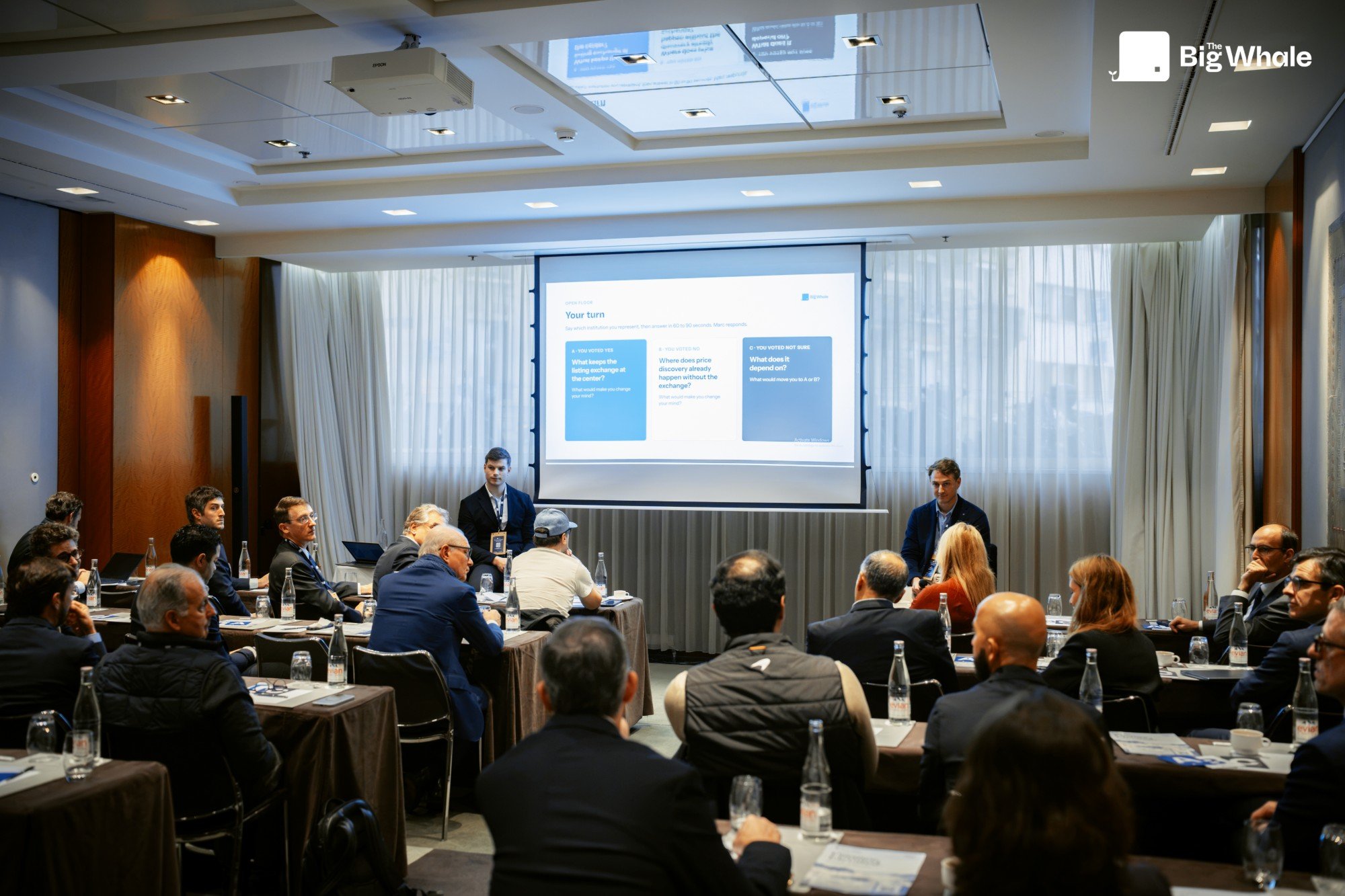
The workshop opened with a vote on one question: in 2030, will the exchange that lists a stock still set its price? The room split roughly into thirds between yes, no and not sure. Marc Tillement answered no, and started with history. For about fifty years, the price of gold was set each day by a handful of bankers in a London room, until futures arrived in the 1970s and ETFs later. Oil followed the same path, from OPEC and the oil majors to CME's WTI futures in the 1980s, ICE's Brent and now contracts in Shanghai. In each case, the price left the venue where the asset was first priced.
US equities are going the same way. Marc Tillement cited Reg NMS, dark pools and alternative trading systems since the mid-2000s, and gave two figures:
- The NYSE handled 80% of single-stock volume twenty years ago, and about 25% today
- Around half of US single-stock volume now trades off-exchange
For Marc Tillement, listing exchanges will remain where companies go public and will stay strong at the open and the close, while trading around those moments moves elsewhere. Some are already testing longer hours, although CME stepped back from extended WTI trading, citing staffing more than market concerns.
Perpetual futures as the 24/7 instrument
The second driver Marc Tillement described is new instruments. Perpetual futures, which use a continuous funding rate to keep the derivative close to its underlying, gave crypto its first 24/7 products, and the same design can be applied to US equities or any other asset. Holders give up voting rights, but according to Pyth data traders on these venues hold a position for about ten hours on average, and care about price action more than governance.
Marc Tillement cited an Nvidia news story reported after the US close: within an hour, $1.2 billion traded on Hyperliquid on Nvidia, and the market priced a drop of about 15%. For investors in countries where buying Nvidia shares is close to impossible, these instruments are often the only way in, which is why Marc Tillement does not expect offshore venues to disappear once regulated exchanges trade around the clock.
Who keeps prices aligned across venues?
On price efficiency, Marc Tillement expects trading firms to close gaps between venues through arbitrage, and noted that the SEC is considering changes to Reg NMS, under which a broker cannot yet route an Apple order to a blockchain-based venue. Gaps still happen: when the designated market maker for a tokenized Apple share went down for two hours, the token traded about 20% above the after-hours price.
Participants were less confident:
- A participant from a trading firm said firms that trade the same asset on many venues cannot consolidate their positions reliably at any given moment, and that no technology solves this today
- A buy-side participant said the question will not be settled by 2030, because US accounting rules still require end-of-day prices from the main venue
- Another participant noted that non-bank market makers derive their prices from exchange data, whose use is required by law
Marc Tillement agreed that tokenized equities add a layer of complexity: Securitize issues shares natively, while issuers such as Ondo or xStocks use SPVs, so their tokens cannot be marked one-to-one against the same share. Marc Tillement expects some form of consolidated international tape within the decade.
Reference prices versus executable prices
A participant from a regulated index provider urged institutions to choose benchmark and data providers carefully, and to prefer regulated ones whenever a financial product is involved. Marc Tillement drew a line between theoretical index prices and executable prices. Pyth builds its prices from data contributed by trading firms such as Jump Trading, GTS, Jane Street and DRW, and by exchanges such as LMAX, which send the midpoint of their order books. Its data is a reference and is not executable, and most of its customers are exchanges.
Pyth is also building its own 24/7 indices: single-name US equities, and baskets of the top 30, 100 and 500 US stocks. Marc Tillement expects to have the methodology reviewed under benchmark rules, although customers have rarely asked for it so far, apart from brokers that also offer onchain trading. For Marc Tillement, regulation comes second: without the data, no index can exist.
Funds, NAV and the cost of instant settlement
Several asset managers asked how continuous pricing applies to funds:
- Money market funds are the easiest case because they are valued at amortised cost
- For a Bitcoin ETF, the underlying trades 24/7 but the fund does not, and serving Asian investors outside US hours requires market makers with large balance sheets
- A participant said continuous NAV requires the fund's terms in machine-readable form, and that custodian banks are not ready for it
- Another participant described a trade-off between valuation and immediacy: a pension fund can wait for a better spread, while a crypto trader will pay to settle now
Marc Tillement answered that a 24/7 reference price lets a fund manager act before the next open, for example by hedging after an overnight move such as the Nvidia drop.
Spreads and tokenized equities
Marc Tillement expects spreads to tighten over time, as they have over the past twenty years, as long as high-frequency trading firms compete on each venue. A participant from a market maker that quotes tokenized equities on several chains described the current constraints outside US hours:
- Four to six different wrappers of the same stock on different chains, with no interoperability
- No prime brokers and no borrowing market
- Thousands of stocks pre-funded on multiple venues, which ties up capital
- Inventory that runs out at weekends when retail buys, leading to large price swings
According to this participant, it will take several years for market infrastructure to catch up. Marc Tillement expects a winner-takes-all outcome among tokenization issuers. Another participant questioned models that rely on blacklisting rather than whitelisting and distribute offshore without KYC, arguing they will face regulators as they scale. Marc Tillement's pick is Securitize, which issues shares natively and requires KYC, even though it has tokenized only a few equities so far.
Conclusion
The discussion kept coming back to one question: which prices can institutions rely on as trading hours extend? Participants listed what still stands in the way: positions spread across venues, accounting rules tied to the primary exchange, tokens that are not fungible and capital locked on every venue. In the final vote, only two of the undecided participants changed their answer. Marc Tillement closed by noting that fund managers, trading firms and exchanges need different things, and that a 24/7 reference price will still be useful to institutions that cannot trade on it.